How to Control Plasma in a Fusion Power Plant?
Fusion Power Plant (FPP) is the next frontier ultimate energy source that makes fossil fuels power plants look like yesterday’s news. One of the core challenges within these advanced facilities is plasma control, a multifaceted problem demanding cutting-edge solutions [1]. We have an idea how to approach this problem — develop a plasma-state-oriented control system for FPPs. This article will concisely address the plasma control challenges that must be overcome and explore potential solutions.
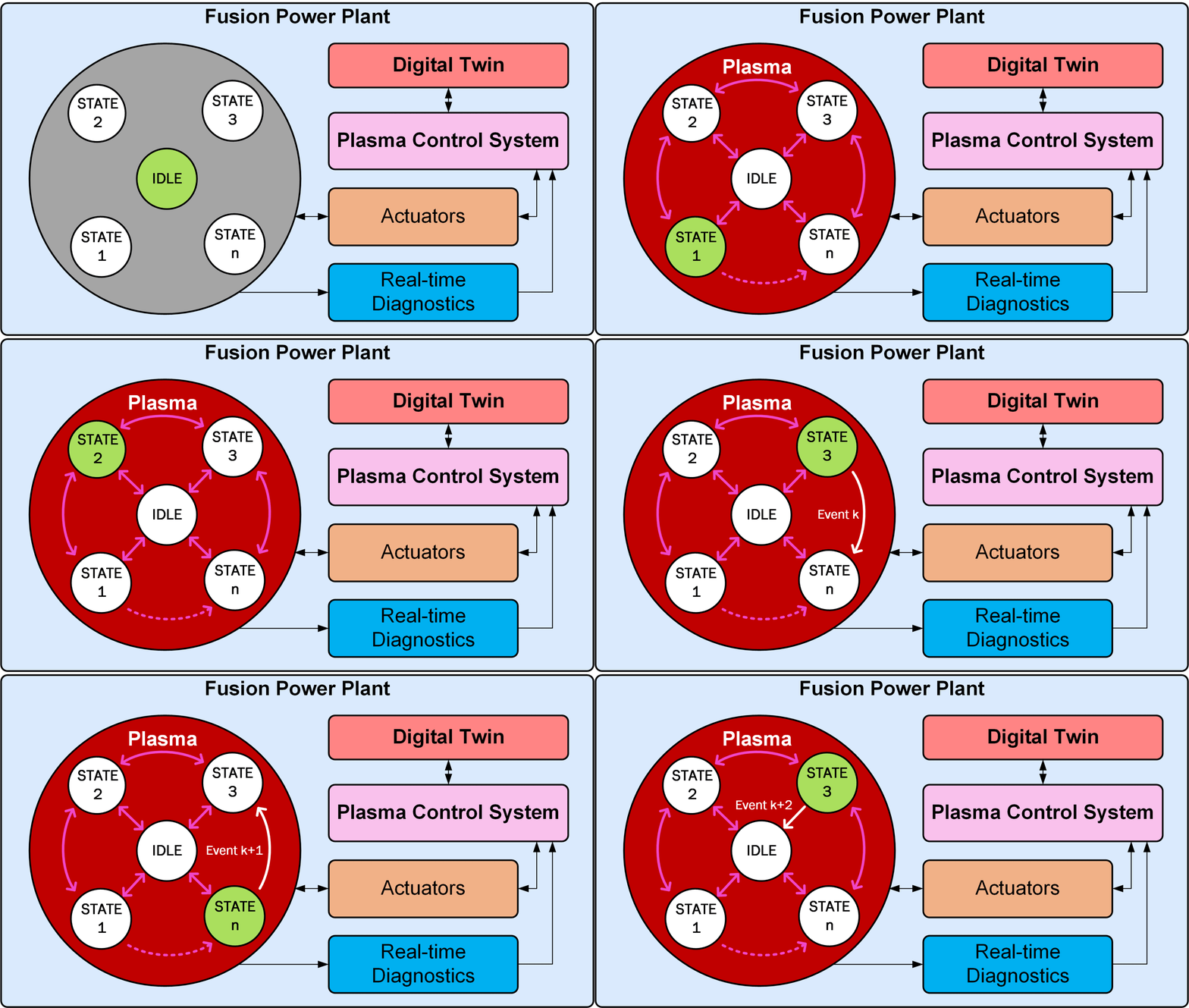
Fusion Power Plants: Beyond Experimental Tokamaks
FPPs mark a significant leap forward from current experimental tokamaks like JT-60SA, KSTAR, EAST or even ITER. While existing devices aim to demonstrate scientific and technological feasibility, FPPs are designed to be fully operational power plants, continuously generating electricity for the grid. Due to its specific characteristics, an FPP utilizing magnetic confinement will encounter three primary plasma control challenges:
- Poor data from diagnostics. The high neutron fluxes in future Fusion Power Plants mean that many diagnostic methods currently used in experimental tokamaks will be incompatible. Thick neutron shielding will require moving the remaining diagnostics away from the plasma.
- Weak actuators. The blanket and shielding create large plasma-coil gaps. As a result, we have weak magnetic control. Fast magnetic control is not possible, and responding to rapid changes in the plasma becomes difficult. In addition, radio frequency heating methods will face challenges and limitations.
- Continuous operation. To be cost-effective, a future FPP should operate in a steady-state, long-pulse regime. This requires robust and high-quality design of control systems. Control algorithms must be capable of handling discrete events, such as pellet injection, ELMs, and others, and also of continuously changing the machine environment due to dust and helium ash accumulation and unavoidable degradation of various systems.
Advanced Plasma Control System
To tackle these challenges, we propose the development of a novel machine-agnostics and plasma-state-oriented control approach, which represents a paradigm shift from traditional control methods. Instead of focusing on individual plasma parameters, this approach aims to maintain the plasma in specific, desirable states characterized by multiple interdependent variables. This holistic strategy is better suited to the complex, nonlinear nature of fusion plasmas. Machine-agnostic control methods are capable of representing the plasma state of any magnetic confinement machine (tokamak or stellarators). This should be ensured by defining the states as a number of plasma performance characteristics common to any machine, which require multiple layers of abstraction for the machine geometry, plasma configuration, actuator definition, and performance goals.
To ensure the reliable operation of the FPP, the operator should choose limited operation patterns like “start”, “output power control”, and “stop”. In the final phase of the FPP development, minimal freely adjustable plasma control parameters should exist, except for a few macroscopic operational options [1]. Therefore, the plasma state control approach naturally covers many FPP-relevant tasks, in contrast to a rigidly defined discharge scenario.
Key aspects of plasma-state-oriented control include:
- Definition of target robust plasma states that optimize fusion performance and stability. For example, plasma steady-state burns with a 70% energy output of the capacity until a command to change power output is received.
- Real-time reconstruction of the current plasma state.
- Anticipating state transitions through predictive modeling, for example, when needed to change output power.
- Coordinated actuation of multiple control systems to guide the plasma towards the desired state, avoiding events, which eventually may lead to machine damage [3].
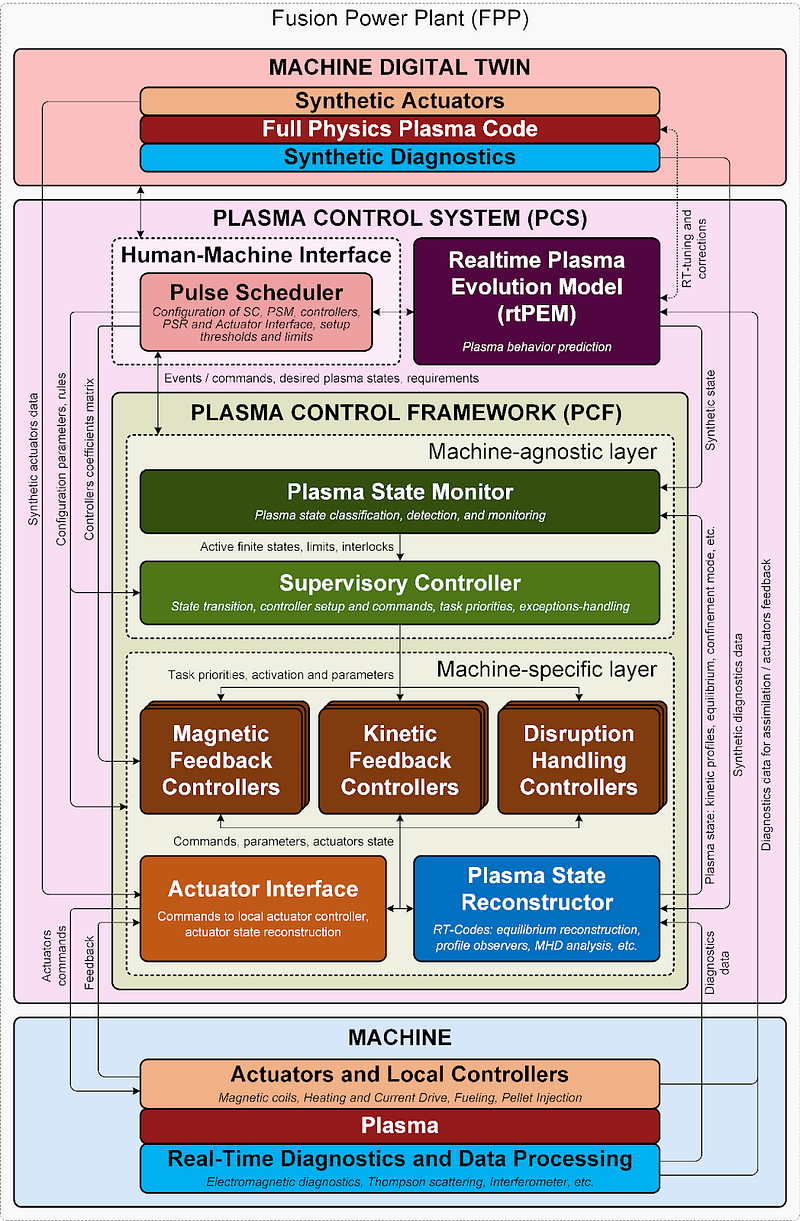
The central component of the proposed Plasma Control System (PCS) is the machine-agnostic Plasma State Monitor (PSM) [2]. This advanced classifier employs both classic and machine learning (ML) models to provide a detailed representation of the plasma state through the finite state machines (FSM) concept. The FSM approach is based on the idea that a system can only be in one of a finite number of states at any given time [4]. In this context, the plasma state is a discrete set of variables (that characterise plasma parameters) and continuous processes (that characterise plasma behaviour) bound by requirements with threshold conditions, and captures all relevant information about a plasma’s past and present needed to determine its future behaviour. First, it is necessary to compile a set of possible plasma states and formalize the conditions of transitions between them. To determine the state, it is important to classify it as pre-disrupted or stable. Machine learning classifiers and model-based codes are both viable options for this task.
The Plasma State Monitor collects data from the Plasma State Reconstructor and Realtime Plasma Evolution Model (rtPEM). The Plasma State Reconstructor tracks measured and simulated plasma parameters to create a comprehensive, real-time picture of the state. Several advanced techniques can be employed for plasma state reconstruction: Bayesian inference [12], Kalman filtering [5], real-time boundary reconstruction methods [6], and others. The rtPEM uses real-time surrogate models, linearized model of actuators, and diagnostic simulations to provide accurate simulations for the machine setup.
Plasma state reconstruction in FPPs faces several challenges:
- High-dimensionality. The plasma state is characterized by numerous interdependent variables, making full state reconstruction computationally intensive. The development of reduced-order models that capture essential plasma dynamics while remaining computationally tractable can help here.
- Temporal resolution. Plasma dynamics can evolve on microsecond timescales, requiring extremely fast reconstruction algorithms. Here, again, various machine learning techniques can come to the rescue.
- Limited diagnostic access. The harsh environment of an FPP limits the number and types of diagnostics that can be employed, necessitating advanced techniques to observe non-measured plasma parameters using data assimilation‑based control [7]. The basis of this approach, to put it simply, is the mixing of real measurements from plasma diagnostics and synthetic data taken by modeling the plasma behavior in real-time.
- Uncertainty quantification. Accurate estimation of uncertainties in reconstructed parameters is crucial for robust control decisions. We can handle this by implementing real-time capable Gaussian Process regression for fast, uncertainty-aware state estimation.
Let’s return to our PCS diagram. The Plasma State Monitor sends the state description to the Supervisory Controller, which coordinates multiple plasma control tasks like equilibrium, fueling, or heating. It priorities these tasks based on the current and desired plasma states. In traditional approaches, control algorithms run independently and can interfere with each other. The Supervisory Controller makes decisions to avoid interference or adjusts control policy using the indirect effect of some actuators. It also handles exceptions, such as machine damage or safety events like preventing plasma disruption or heat overload. Feedback Controllers in machine-specific layer continuously adjust control actions to enhance plasma performance by responding to real-time measurements from PSR. Controllers have machine-agnostic mathematics, but machine-specific coefficient matrices and limitations (operational space, requirements). Machine learning specifically reinforcement learning (RL) modules can be optionally used as some of the controllers. The Actuator Interface provides interaction between the actuator local controller and PCS Feedback Controller, defines the Actuator limits and reconstructs the actuator state. Pulse Scheduler used for compilation and schedule of all Machine control parameters, defining desired plasma states, thresholds, and limits for a shot.
The Plasma Control Framework (PCF) integrates machine-agnostic and machine-specific layers, ensuring alignment with stakeholder needs and industry standards. PCF is the basis for the convenient assembly of all PCS components from modules based on the task and the current stage of the specific machine experiments. PCF has to ensure reliable and uninterrupted operation of the PCS algorithms in real-time. Existing PCS frameworks (e.g. MARTe or DCS) already have the reliable background needed for the implementation and testing of new approaches, but also have specific limitations and inconveniences for developers that we would like to overcome [8].
In a simplified form, all the above can be represented in the control cycle diagram (Fig. 2).
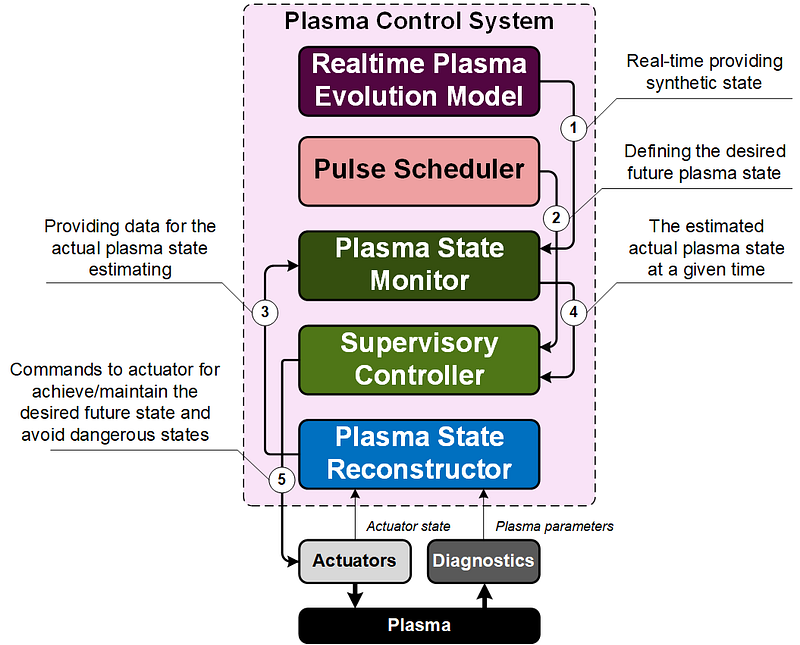
Determining all FPP possible plasma states and the transition condition between them has not yet been a solved task. We would like to approach this track using all the existing knowledge in this area. Resolving the full scope of challenges in implementing a successful approach is difficult. Techniques like the Dependency Structure Matrix [9] can help here, but this is a topic for one of the future articles.
FPP Digital Twin: Virtual Representation of a Machine
The development of FPP control system is greatly facilitated by the concept of Digital Twin — high-fidelity virtual replica of the physical plant. The sophisticated simulations integrate multiple physics models, including magnetohydrodynamics, heat transfer, and neutronics, to provide a comprehensive representation of the FPP’s operation. It is used not only for plasma behaviour prediction but also for synthetic data generating, which can be compared with the actual measured data or the real data supplement [7]. In the perfect case, indicators of synthetic diagnostics and actuators should not differ from real ones. The difference between them will indicate the appearance of multiple possible problems, such as degradation, sensor damage, inadequate plasma response, etc. The Plasma State Monitor will perform integrated data analysis as a central part of the proposed PCS approach. Coupling a Digital Twin with the Realtime Plasma Model allows the synthetic description of plasma and its behaviour. This will open up the opportunity to introduce synthetic diagnostics complementary to real ones. It requires the development of faster-than-real-time codes, or pre-generating as a set of multidimensional plasma parameters space, that is classified in real-time using real-time compatible tools.
Periodic verification of the currently used rtPEM during the discharge process is essential to check the error magnitude in the provided data. This verification allows one to decide when the system can switch to the next pre-calculated model or start the tuning process of the rtPEM for the new discharge conditions directly during the discharge. As shown in Fig. 1, inside Machine Digital Twin we have a Full Physics Plasma Code based on solving the physics equations, which allows robust solutions for any plasma state. During the tuning process, this code should be called for the rtPEM module solution verification. If the solution does not match, the Full Physics Plasma Code recalculates the matrices for the rtPEM module and replaces them during the discharge. Because this process takes a relatively long time (about 100–200 ms) compared to the control cycle, we should use a “semi-emergency” control mode in this case.
Long-pulse and continuous operation requires the online update of the Digital Twin setup to correctly represent machine conditions. In order to address this challenge, data should be assimilated for uncertainty minimisation, as well as adaptive model predictive control implemented. These measures will ensure robustness, estimate uncertainties, and meet performance requirements throughout the entire lifespan of the machine.
ML-Based Control: Harnessing AI for Fusion
Machine learning will be applied to plasma control in FPPs, offering the potential for improved performance and stability. ML-based control systems can predict plasma behavior and potential instabilities milliseconds in advance [10], optimize actuator parameters for controlling the desired plasma states, and adapt control strategies with avoiding or even intentionally using actuators’ overlap in real-time based on changing plasma conditions [11].
These ML models are trained on vast datasets generated from both experimental tokamaks and high-fidelity simulations, allowing them to generalize across a wide range of operational scenarios.
By and large, it is still unknown exactly how machine learning works, which processes inside ML models lead to decision-making. In control science, nobody likes black-boxes, but in some cases, no matter how it works, if it works well.
Conclusion
Controlling plasma in the future Fusion Power Plant represents one of the most challenging and crucial aspects of realizing commercial fusion energy. The integration of advanced plasma state reconstruction techniques with plasma-state-oriented control strategies and machine learning approaches offers a promising path forward.
We welcome you to provide feedback in the comments section, share your thoughts, propose alternative approaches or improvements to the methods discussed, and highlight potential challenges or limitations you foresee. To express your interest in collaboration or to provide detailed feedback, please contact us here or by e-mail.
By joining forces, we can stretch the limits of plasma control science and move closer to realizing the vision of clean, limitless fusion energy.
References
[1] Plasma Control Systems Relevant to ITER and Fusion Power Plants. K. Kurihara et al.
[2] Real-time plasma state monitoring and supervisory control on TCV. T.C. Blanken, Federico Felici, et al.
[3] Plasma control for the STEP prototype power plant. M. Lennholm, S. Aleiferis et al.
[4] “Finite State Machines” Wright, David R. (2005)
[5] A dynamic state observer for real-time reconstruction of the tokamak plasma profile state and disturbances. Federico Felici, Marco De Baar et al.
[6] Real-time plasma equilibrium reconstruction and shape control for the MAST Upgrade tokamak H. Anand et al.
[7] First application of data assimilation-based control to fusion plasma. Yuya Morishita et al.
[8] Coupling DCS and MARTe two real-time control frameworks in collaboration. Christopher J. Rapson, Pedro Carvalho et al.
[9] Managing the complexity of plasma physics in control systems engineering. T.F. Beernaert, M.R. de Baar et al.
[10] Avoiding fusion plasma tearing instability with deep reinforcement learning. Jaemin Seo et al.
[11] Magnetic control of tokamak plasmas through deep reinforcement learning. Jonas Degrave, Federico Felici et al.
[12] Machine learning and Bayesian inference in nuclear fusion research: an overview. A. Pavone et al.