How to Measure Plasma in Fusion Power Plants — Part I: Diagnostics
Part I: Diagnostics
Introduction
In tokamak fusion devices, plasma is the control object that can be shaped and sustained using magnetic fields, radio-frequency waves, gas puffing, pellets, and neutral particle injection. To decide when and how to apply a control action to a plasma, we first need to know its current state, which is represented in the multidimensional space of plasma parameters. As we can’t insert instruments into a 100-million-degree plasma, we rely on diagnostics — indirect measurements that allow us to infer key parameters and track the plasma state over time.
In experimental research machines, the main “profit” is data. The broader and more accurate the diagnostic complex is, the more parameters can be measured, cross-checked, and compared, leading to a deeper understanding of plasma physics. Consequently, modern research tokamaks are usually equipped with a broad and diverse set of diagnostics.
A commercial fusion power plant (FPP) has a different mission: to produce electricity safely, efficiently, and reliably. Here, the goal is not to measure everything, but to measure the right things with a minimal, yet robust, set of diagnostics that enable control, protection, and regulatory compliance. This represents a paradigm shift from the current focus on research-based diagnostic abundance [1]. Unlike research facilities, an FPP does not need to discover new physics in operation; it needs diagnostics that are necessary and sufficient to:
- Keep the burning plasma within operational limits,
- Detect and respond to off-normal events,
- Optimize performance over long discharges.
This first section of the article addresses the essential diagnostics for FPPs and the selection process for these tools. We will propose criteria to establish a minimal yet reliable set of diagnostics, crucial for ensuring safe, efficient, and economically viable operation.
The diagnostics landscape
Over 70 years of tokamak development, with more than 200 devices built worldwide, have produced a vast ecosystem of plasma and machine diagnostics. This innovation continues today, with new neutron-resistant sensors and diagnostic methods being developed and tested [2]. We briefly describe the current variety of tokamak diagnostics and explain how specific criteria can be used to group them:
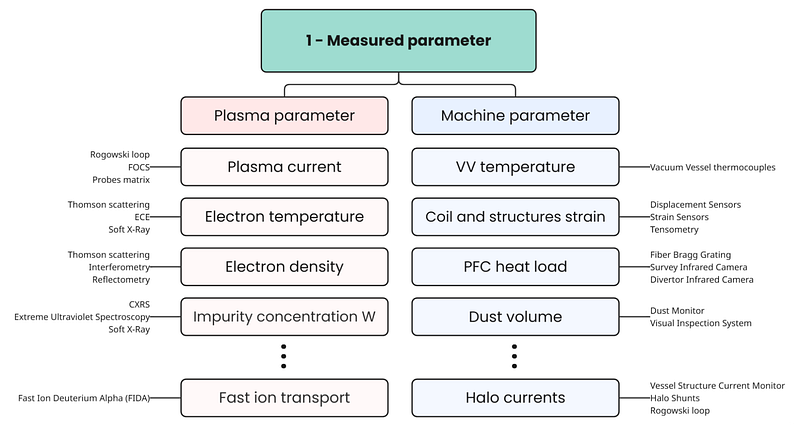
1) By measured plasma parameters. Over a hundred parameters can be inferred, and many diagnostics provide multiple quantities. For example, Thomson Scattering can yield both electron temperature and electron density profiles [3]. An example of such a grouping of diagnostics is illustrated in the diagram (Fig. 1), which includes several examples.
The entire variety of plasma and machine parameters from existing research tokamaks is presented in the Integrated Modelling & Analysis Suite (IMAS) Data Dictionary [4]. By enforcing consistency in naming, structure, and metadata, the IMAS framework enables seamless exchange of information between diagnostics, simulation codes, and control algorithms. For example, a diagnostic measurement of electron density can be directly mapped to the same parameter in a transport model or a plasma control system without ad-hoc conversions. This interoperability is practical not only for collaborative research across devices but also for FPPs, where validated digital twins and control platforms will need to rely on a common language of plasma parameters to ensure reliability, regulatory compliance, and maintainability.
2) By temporal requirements. Some parameters must be observed in real time for plasma control (e.g., plasma current, position, density). In contrast, others do not require real-time monitoring during or between discharges for analysis (e.g., vacuum vessel temperature, wall conditions). Several examples are shown in Fig. 2.

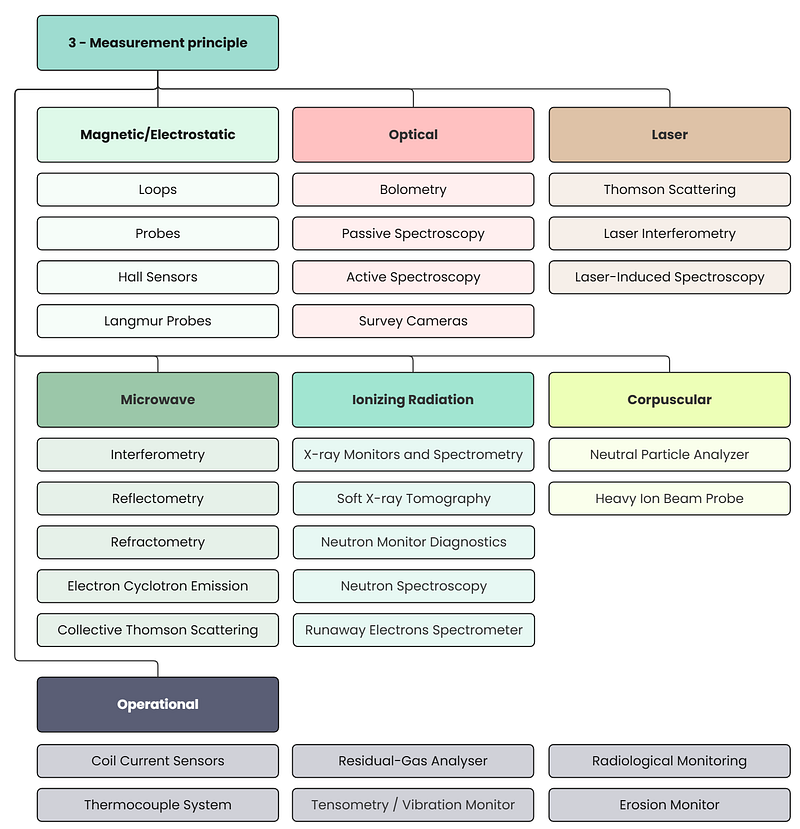
3) By the measurement principle. Magnetic/electrostatic probes, optical and laser diagnostics, microwave diagnostics, ionizing radiation detectors, and corpuscular (particle-based) diagnostics (Fig. 3). A subset of these — operational diagnostics — primarily monitor the machine itself rather than the plasma (e.g., coil currents, thermocouple systems).
Magnetic diagnostics detect fields and currents induced by plasma motion, utilizing flux loops, Rogowski coils, and Mirnov probes to translate electromagnetic induction into measurable signals. Optical diagnostics capture emitted light (e.g., spectroscopy for impurity lines, imaging for shape, and bolometry for total radiated power), while laser systems, such as Thomson scattering, use photon–electron collisions to infer density and temperature profiles. Microwave diagnostics, such as interferometry and reflectometry, rely on wave–plasma interactions to measure phase shifts or reflections that encode density. Ionizing radiation detectors (e.g., X-ray detectors, neutron monitors) register particles escaping from the plasma, using their energy and angular distributions to reconstruct the fusion rate. Finally, corpuscular diagnostics (e.g., neutral particle analyzer and heavy-ion beam probe) operate based on the motion and interaction of particles. Together, these complementary methods provide a multi-physics view of the plasma state.
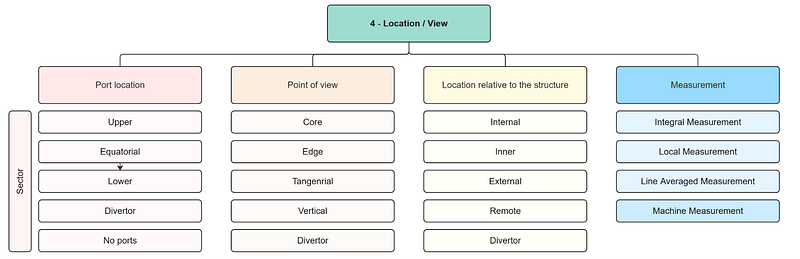
4) By location and geometry. Diagnostics can be placed in ports and sectors, aligned along specific viewing angles, or located inside versus outside the vacuum vessel, targeting core, edge, or divertor regions of the plasma (Fig. 4).
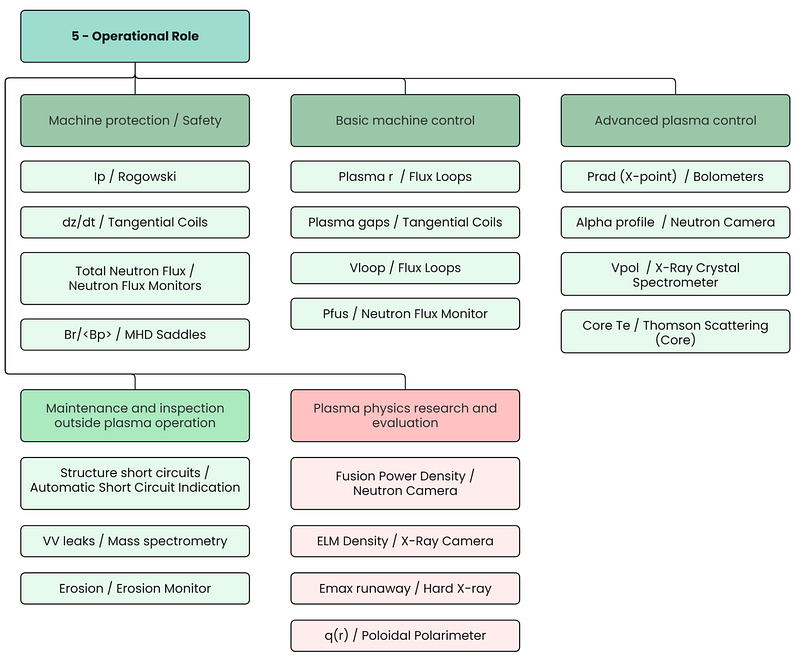
5) By operational role. The parameters and the diagnostics used to observe them can be used for various purposes — machine protection and safety, basic machine control, advanced plasma control, maintenance and inspection outside plasma operation, plasma physics research and evaluation (Fig. 5). Obviously, diagnostics from the last list are not necessary for FPPs, however, based on the experience of their use in research facilities, these diagnostics may move to other groups or be excluded.
Selecting diagnostics for an FPP
How do we filter this vast diagnostic “zoo” into a practical FPP-ready suite? The process can be described in stages (Fig. 6):
- Define essential parameters — Identify which plasma and machine parameters are indispensable for plasma control and machine protection. Exclude those aimed purely at advancing physics research. Detailed physics-exploration diagnostics (e.g., turbulence imaging, fluctuation studies) are not necessary for FPP operation. Based on these fundamental assumptions, we will define an initial set of diagnostics by cutting out the excess.
- Assess survivability — Many conventional diagnostics will fail under high neutron flux and gamma radiation during a long-pulse operation. FPP diagnostics must be designed for remote replacement by robotic manipulators, featuring shielded connectors and modular ports for easier swap-out, as well as calibration procedures that minimize human access. Technologically complex diagnostics or those that cannot function reliably in reactor-relevant conditions should be excluded. For example, Thomson scattering is a gold standard for electron temperature/density profiles in research, but laser optics is unlikely to survive FPP conditions without major innovation. Optical diagnostics (e.g., visible spectroscopy or survey cameras) are too fragile for FPP conditions. However, studies are being conducted to advance optical [5] and laser [6] systems, and researchers are working to overcome the limitations of a reactor-relevant environment.
For reference, the neutron flux in commercial FPPs will be moderately higher (up to x10) than in current fission reactors. However, the primary challenge comes not from the magnitude of the flux but from the dramatically higher neutron energy (14.1 MeV for fusion vs. 2 MeV for fission, on average), which creates disproportionately severe material damage despite similar flux levels. This energy difference makes fusion neutron environments roughly 100 times more damaging to materials than equivalent fission neutron fluxes. Therefore, survivability becomes a primary criterion for selecting a diagnostic. - Optimize the trade-offs — Among the surviving options, choose those with the best balance of accuracy, reliability, durability, complexity, and cost-effectiveness. Essential conditions for the FPP diagnostics integration into the machine are:
– Minimizing the footprint of diagnostic equipment on the first wall. This surface is essential for two key functions: efficiently transferring heat to the turbine-generating circuits and facilitating tritium breeding.
– The possibility of hot-swapping for repair and maintenance of diagnostics during the short inter-discharge pause. - Validate in pilot plants — The final set must be tested in pilot FPPs operating under near-commercial conditions before deployment in true power plants.
- The operational experience of the first serial FPPs will help refine (or supplement or reduce) the set of diagnostic systems. Next-generation FPPs will feature the most modern and reliable systems for determining plasma parameters.
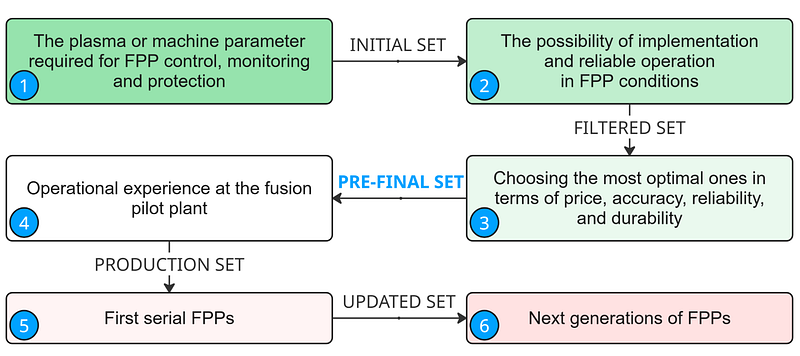
Within the current understanding, we can only define a preliminary, pre-final set of diagnostics (stage 3). Specific parameters, such as plasma current, density, and neutron flux, are so critical that they require redundant measurements using independent diagnostics. This ensures that a single diagnostic failure does not compromise plant safety. The redundancy principle, well-established in aerospace and fission plants, will also be central in fusion.
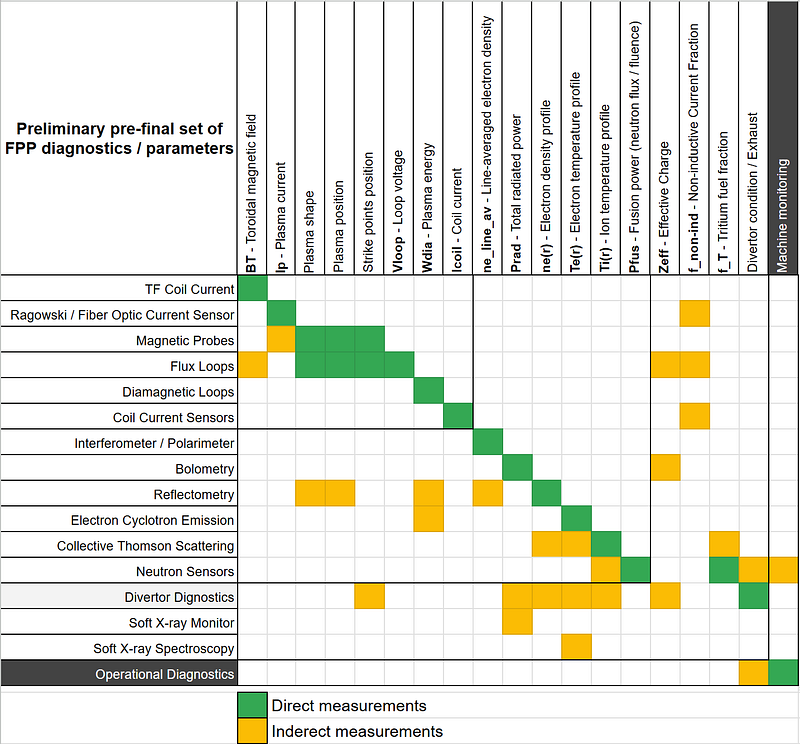
Taking into account the prerequisites described above, we have formed a preliminary set of diagnostics for the FPP, shown in Fig. 7.
Standardization
A likely trend is the standardization of FPP diagnostics. Instead of each plant carrying a bespoke set, regulators and industry may converge on a baseline suite of essential diagnostics (Fig. 7). Standardization would reduce costs, simplify certification, and ensure interoperability across different plant designs. Lessons from the nuclear fission industry, which has decades of experience in designing radiation-hardened sensors for long lifetimes, suggest that standardization accelerates licensing and improves operator training.
For industrial diagnostics, a unified baseline of parameters, naming conventions, and data formats is essential, all integrated within a shared data structure and communication protocol. The aerospace and aviation sectors provide a valuable comparison: aircraft avionics and flight data systems operate on standardized protocols. This enables instruments from various manufacturers to work together, feed information to central flight computers, and meet safety regulations. Far from stifling innovation, this standardization has fostered competition, streamlined certification processes, and built confidence in the reliability of these systems across entire fleets.
Conclusions
A commercial FPP requires a minimal but sufficient diagnostic suite that balances physics insight with industrial practicality. The selection process involves:
- Defining diagnostics that can provide essential parameters for control, safety, and compliance;
- Eliminating diagnostics unlikely to survive FPP conditions;
- Choosing the most robust, cost-effective, and maintainable solutions;
- Designing for minimizing footprint, remote maintenance, and hot-swap possibility;
- Validating in pilot plants before standardizing across the industry.
Ultimately, the diagnostics set of an FPP will not resemble the “zoo” of research tokamaks. Instead, it will be lean, reliable, redundant, standardized, and highly integrated with the plant’s control and protection systems, enabling fusion energy to be delivered safely, efficiently, and economically.
Next Step Fusion is a supply chain company supporting tokamak developers in the design, simulation, optimization, control, and operation of their devices through integrated modeling and AI/ML-enabled solutions.
We invite you to be part of this groundbreaking journey!
At the moment, we’re very open to discussion and cooperation with specialists in fusion diagnostic systems!
Follow our blog on Medium, subscribe to our LinkedIn for regular updates, watch our videos on YouTube, or reach out to us directly to discuss potential collaborations.
References
[3] M. Amarika et al., ITER Core Plasma Thomson Scattering diagnostic design. Fusion Engineering and Design 203 (2024).
[4] https://github.com/iterorganization/IMAS-Data-Dictionary