ISTTOK Tokamak Engineering Adventures
Our journey into plasma control on the ISTTOK (large aspect ratio compact tokamak) using machine learning (ML) controllers began in the summer of 2024, following the signing of a cooperation agreement with Instituto Superior Técnico. At Next Step Fusion, one of our primary objectives at ISTTOK is to leverage ML to optimize critical stages of plasma operation, such as the breakdown and ramp-up phases [1]. Rafael Henriques, a tokamak plasma operation specialist who began his scientific career at ISTTOK, helped us address all the technical and organizational issues. And for the most part, the resolution of all engineering issues on the tokamak is his merit, for which we are immensely grateful to him and his colleagues.
During the preparation for experiments on the ISTTOK, we faced several challenges, including unusual alternating current regimes for tokamaks, suboptimal vacuum conditions, power blackout, and numerous other minor hurdles. This article outlines how we overcame these obstacles on the path to achieving our goals.

Device Features
ISTTOK (Instituto Superior Técnico TOKamak) is a fusion research facility located in Lisbon, Portugal. Operational since the early 1990s, it has been utilized for alternating plasma current (AC) discharges, studying edge plasma turbulence, and testing liquid metal limiter concepts. A 15 mm thick and toroidally interrupted copper shell (conducting metallic structure) surrounds the ISTTOK’s vacuum vessel, which has a major radius R0 = 0.46 meters and a large aspect ratio A = 5,41. Circular-shaped plasma is purely ohmically heated and constrained by a 360-degree poloidal graphite limiter, consisting of 12 blocks.
AC discharges allow the fast reversal of the plasma current up to ±7 kA on consecutive flat tops while maintaining a finite plasma density [2]. During the AC discharges, the toroidal field Bφ is kept unchanged. Still, the plasma current inversion results in the generated poloidal field reversal, which requires a change of the equilibrium vertical field sign to achieve the desired toroidal force balance.
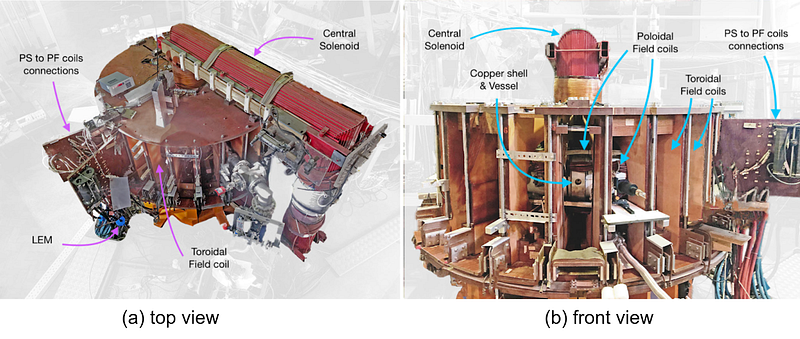
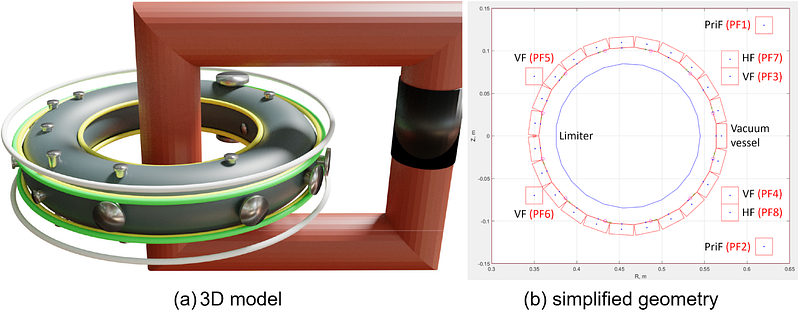
ISTTOK’s poloidal field (PF) coils, which generate plasma current and control the plasma position, are connected to three groups with independently feedback-controlled power supplies: horizontal field coils (HF), vertical field coils (VF), and primary field coils (PriF). Previously, the plasma current on ISTTOK was induced using PriF coils (black in Fig. 2) wound on an iron core, which served as a transformer. Now the current in plasma is induced by new PriF coils (white in Fig. 2) because, in addition to the transformer effect, they also produce a vertical magnetic field, which helps for the equilibrium. At the same time, the iron core continues to affect the plasma by its magnetic saturation, which creates particular difficulties for creating ISTTOK’s digital replica and plasma model validation. We will talk about this in one of our future articles.
The toroidal magnetic field (TF) relies on a set of 24 coils to ensure a sufficient magnetic field in the center (0.5 T) with an acceptable ripple on the low-field side.
Technical Challenges
Our goal is to create an ML-regulator for controlling the plasma current and position in AC discharges. To achieve this, we first needed to understand the parameters and properties of the ISTTOK’s set of sensors (magnetic diagnostics) and actuators (magnetic field coils). We began our work with a comprehensive review of the tokamak, gathering specifications for the magnetic system and passive conducting structures, as well as collecting information about the current state of controllers, data acquisition system, and plasma diagnostics.
Some of the machine parameters were not available. They had to be measured or obtained through dedicated experiments, which brought a more detailed characterization of the tokamak itself and its associated components to ISTTOK. We measured the active resistance of all PF coils using a laboratory DC power source and measured their inductance using an LCR-meter at various frequencies.
In preparation for the next experimental campaign, vacuum windows were cleaned, and in-vessel diagnostics were checked. At the first stage, for our purposes of magnetic plasma control, the magnetic diagnostics were sufficient, which include a Rogovsky Coil for measuring plasma current, Voltage Loops for measuring plasma position, and Mirnov coils (probes) for measuring magnetic field fluctuations. By comparing model data with experimental data reference shots, we calibrated and refined the location and orientation map of all magnetic sensors necessary for the correct operation of our model. We discovered that some of the magnetic sensors failed, but there were enough functioning sensors to control the plasma. We have carefully sorted through all the diagnostic cables and relabeled them, and checked the input/output channels of the data acquisition system.
For the plasma restart, we faced some technical challenges related to the vacuum system due to the absence of a functioning vacuum sensor. The new sensor delivery had been significantly delayed, preventing the machine from restarting and operating. To avoid the usual bureaucratic processes inherent in universities, we ordered the necessary sensor ourselves and expedited the start of the experiments.
For the condition of the vacuum vessel and in-vessel components, such as limiters, baking and cleaning discharges (also known as glow discharges) are typically used. Baking is a process of heating the vessel to temperatures higher than the normal or nominal ones, with simultaneous vacuum pumping to enhance outgassing. Glow discharges are “continuously pulsed” weakly confined plasma. When functioning correctly, cleaning discharges are run for several minutes (typically half an hour). But in our case, the conditioning process was not recovering as quickly as usual, partly due to the inability to run glow discharges, which resulted in a slower reconditioning of the machine. Despite this still being the primary challenge in ISTTOK, improvements in conditioning and plasma performance are significant, being closer to the nominal parameters.
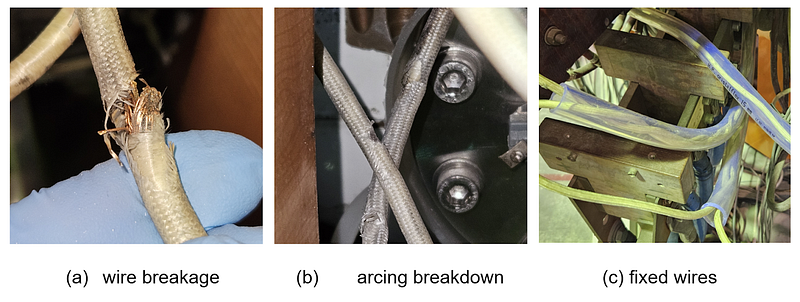
During baking sessions, we detected wire breakage and arcing breakdown of the PriF coils’ insulation (Fig. 3a and 3b). Surprisingly, it did not affect plasma. The malfunction was fixed using a heat-shrinkable sleeve, Cristalflex tubes, and polyethylene linings (Fig. 3c).
On 28 April 2025, a significant power blackout occurred across the Iberian Peninsula, affecting mainland Portugal and the peninsula of Spain, where electric power was unexpectedly interrupted for approximately ten hours [4]. It happened just at the moment when we were conditioning the vacuum vessel. So, we joked that our experiments might have overloaded the power grid. We successfully prevented a significant deterioration of the vacuum conditions during the blackout. Starting on the next day, within a couple of weeks, we improved the vacuum, approaching the nominal conditions significantly.
Conclusions
Following the road to our plasma control goals, in collaboration with colleagues from the Instituto Superior Técnico, we brought the ISTTOK tokamak back to life. Currently, we are achieving AC discharges with a plasma current of up to ±4 kA, with a gradually increasing flat-top value. In future articles, we will describe how we validated the ISTTOK’s Digital Twin and implemented the Machine Learning plasma controller. Stay tuned!
With the ISTTOK digital twin, anyone can conduct experiments in a simulation environment of this interesting machine on our Fusion Twin Platform.
Next Step Fusion is a supply chain company supporting tokamak developers in the design, simulation, optimization, control, and operation of their devices through integrated modeling and AI/ML-enabled solutions.
We invite you to be part of this groundbreaking journey!
Follow our blog on Medium, subscribe to our LinkedIn for regular updates, watch our videos on YouTube, or reach out to us directly to discuss potential collaborations.
References
[1] Next Step Fusion Collaboration with the ISTTOK Tokamak. Next Step Fusion Medium blog (2024)
[2] T. Guerra, M.S. thesis (2008). Real-time measurement of the plasma electron density at ISTTOK. Universidade Tecnica de Lisboa, Lisbon, Portugal, Tech. Rep. 395137798647.
[3] Domenica Corona, et al. Implementation of a High-Speed Multichannel Data Acquisition System for Magnetic Diagnostics and Plasma Centroid Position Control in ISTTOK. 2023.
[4] https://en.wikipedia.org/wiki/2025_Iberian_Peninsula_blackout