Limit-informed pedestal modeling using a surrogate model for MHD stability code MISHKA
How KARHU brings ML-speed MHD stability into NSFsim's pedestal workflow
Introduction
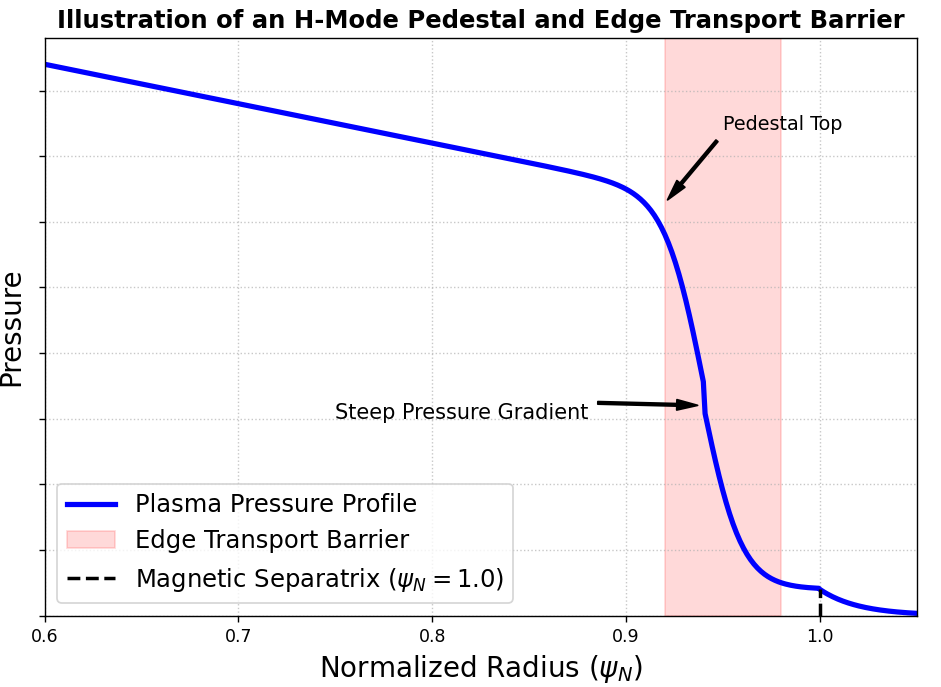
In magnetic confinement fusion devices, such as tokamaks and stellarators, high-confinement regimes (referred to as H-mode [Wagner, 1982]) are characterized by the spontaneous formation of an edge transport barrier (ETB) at the plasma periphery. This barrier results in a region of steep pressure gradients, commonly known as the pedestal. A schematic illustration of a typical pedestal structure is provided in Figure 1. The pedestal height serves as a critical boundary condition for predictive performance simulations. The combination of transport processes and the overall magnetohydrodynamic stability limits the height of the pedestal. An integrated simulation framework that aims to estimate the expected plasma pressure levels in future devices needs representations of these processes.
At Next Step Fusion, we provide predictive simulation services for tokamak design and scenario development. Pedestal modeling is a core component of the integrated modeling framework built around our in-house NSFsim simulator. To enhance those capabilities within our simulation workflow, we have partnered with Dr. Aaro Järvinen's group at the VTT Technical Research Centre of Finland. They have developed KARHU [Bruncrona, 2025], a machine-learning (ML) surrogate model that predicts stability metrics based on the equilibrium and kinetic properties of the plasma. KARHU was trained using the ideal magnetohydrodynamic (MHD) solver MISHKA [Mikhailovskii, 1996]. In collaboration with VTT, we developed a coupling scheme to integrate the KARHU model directly into the NSFsim workflow.
MISHKA code is well-established and widely used in the fusion community. It solves a set of linearized, ideal MHD equations in tokamak geometry. For pedestal modeling, it can be used to estimate peeling-ballooning (PB) stability. For a given plasma equilibrium, the linear growth rate (γNtor) is first calculated across a spectrum of relevant toroidal mode numbers (Ntor) to capture the full range of potential instabilities. Once these linear growth rates are calculated, they are compared against a physical stabilization threshold to determine if the plasma equilibrium is stable or unstable. In this work, we use the Alfvén frequency criterion, which defines an equilibrium as MHD unstable if γmax exceeds 3% of the Alfvén frequency (γmax > 0.03 ωA). Such analysis is time-consuming, since a single simulation takes several minutes and we need to run several of them to build a spectrum over Ntor. Therefore, it is challenging to use it "as-is" in optimization and control tasks that expect high performance from a simulation environment.
The surrogate ML model directly addresses this computational challenge. Initially, the KARHU model was trained exclusively on JET-like parameters, reflecting the specific size, shaping, and plasma performance of JET experimental observations. Our joint project with VTT led to the release of KARHU 2.0, which extends the model's coverage to the DIII-D operational space – characterized by a smaller plasma volume but significantly greater shaping variability. While the underlying methodology remains consistent with original proof-of-concept work [Bruncrona, 2025], this updated version introduces uncertainty quantification (UQ) for the predicted maximum growth rates via a deep ensemble approach [Lakshminarayanan, 2017].
Coupling with NSFsim
We utilize an EPED-like pedestal model [Snyder, 2009] for coupling with the transport solver in NSFsim. An EPED-like model predicts the pre-ELM pedestal top pressure based on ideal MHD stability envelope and a reduced transport model, such as the ballooning critical pedestal,
Δ = C (βθped)0.5(1)
which posits that the pedestal width, Δ (defined in normalized poloidal flux ΨN), scales with the poloidal beta at the pedestal top, βθped, and C = 0.076 is the usual default value in EPED-like models [Snyder, 2010].
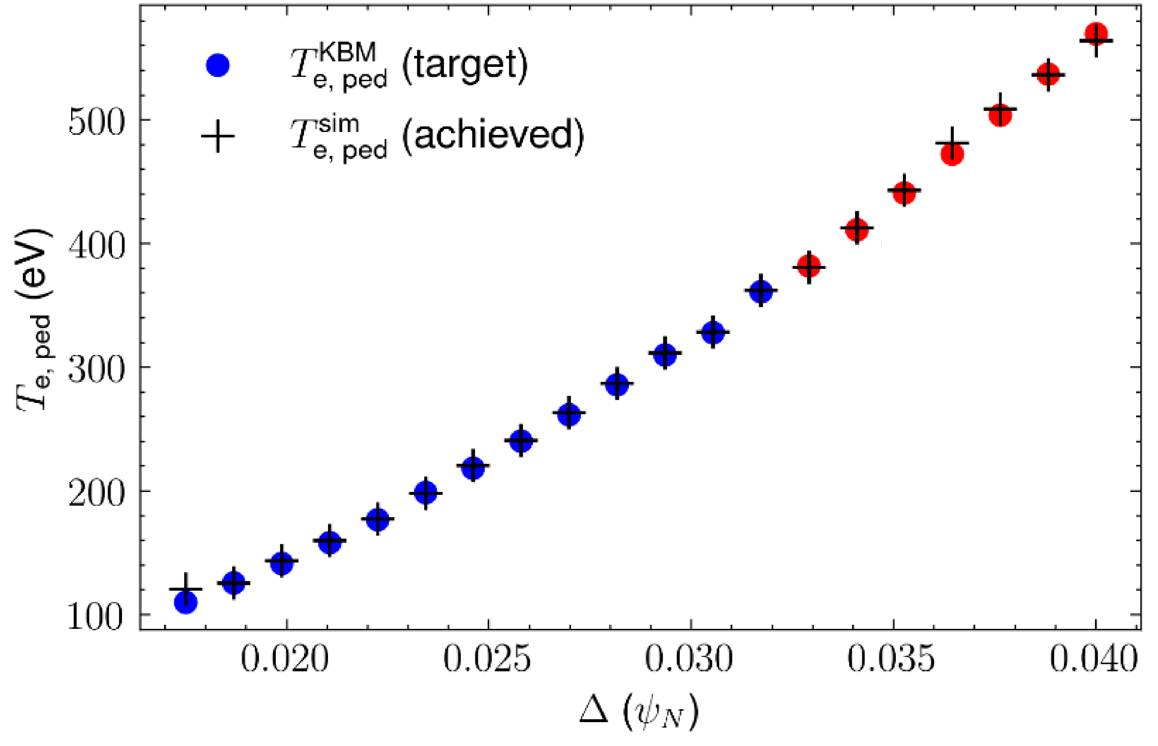
The fundamental assumption in this workflow is that the pedestal density is provided as an input, while the pedestal temperature is increased until the kinetic-ballooning (KBM) constraint (Eq. 1) is satisfied. In a standard EPED-like workflow, this procedure is executed in parallel across multiple pedestal widths. While the KBM constraint provides an estimation of the pedestal width, KARHU evaluates whether the current plasma state remains PB-stable. If the state is stable, transport is reduced within the region defined by width Δ until the PB limit is reached. Satisfying both conditions simultaneously enables the prediction of the maximum attainable pedestal pressure and, consequently, peak plasma performance. The result of such a scan in simulation over two parameters is shown in Figure 2.
Future work
As a next step, we have begun constructing datasets and training new machine-learning surrogate models, similar to KARHU, for additional tokamaks. This process involves sampling the operational parameter space of each target device to generate high-fidelity equilibria and their corresponding ideal MHD stability evaluations. Once trained, these surrogate models will be integrated with NSFsim to facilitate performance optimization and scenario development. We are currently applying this workflow to three distinct devices: a small spherical tokamak designed for medical isotope production, a conventional tokamak for tritium breeding, and the negative triangularity tokamak CENTAUR [Columbia University, 2025]. The latter serves as the primary test bed for our ongoing collaboration with Columbia University. For further updates on these developments, subscribe to our blog and newsletter!
Next Step Fusion is a supply chain company supporting tokamak developers in the design, simulation, optimization, control, and operation of their devices through integrated modeling and AI/ML-enabled solutions.
We invite you to be part of this groundbreaking journey!
Follow our blog, subscribe to our LinkedIn for regular updates, watch our videos on YouTube, or reach out to us directly to discuss potential collaborations.