Next Step Fusion Collaboration with the ISTTOK Tokamak
At Next Step Fusion, we’re constantly pushing the boundaries to bring our technologies closer to reactor-ready status. A key part of this journey involves working with experimental devices, like tokamaks, which provide invaluable testing grounds for plasma control strategies. Around the world, tokamaks are built to explore different areas of plasma physics, resulting in a wide array of diagnostic tools, control systems, and engineering innovations. This diversity offers us a unique opportunity to test and refine our simulations while adopting more advanced technologies into our plasma control approach.
One of our exciting collaborations is with IST (Instituto Superior Técnico), home to ISTTOK — a compact tokamak in Lisbon, Portugal.
ISTTOK is a circular machine with a major radius of 0.46 m and a minor radius of 0.085 m. It creates a compact, circular plasma that is easier to monitor and adjust. The device’s maximum toroidal magnetic field reaches 0.5 Tesla, while the plasma current typically ranges between 5 kA and 10 kA in a 50 ms plasma shot. What’s truly unique is its alternating current (AC) mode [1], where the plasma current reverses direction during a discharge. This capability extends the duration of experiments and opens the door to new areas of research.
ISTTOK’s straightforward design allows for greater flexibility in diagnostics and experimentation. While large tokamaks enable the achievement of more advanced plasma regimes, smaller machines can contribute to the development of new technologies through faster deployment, greater tolerance for risk, and quicker iteration cycles.
A crucial component of ISTTOK’s control system is MARTe (Multithreaded Application Real-Time executor) [2], a cutting-edge real-time framework that allows for fast and reliable control of plasma behaviour. MARTe’s ability to manage multiple real-time tasks simultaneously makes it ideal for plasma control, especially as we integrate machine learning (ML) into these systems. The speed and precision offered by MARTe are essential for developing robust control algorithms that can handle the rapid and unpredictable changes in plasma conditions.
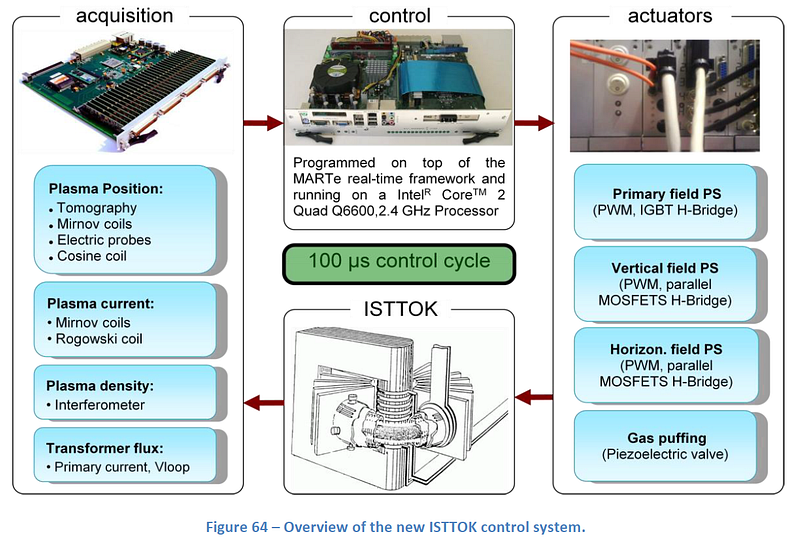
At Next Step Fusion, one of our primary objectives at ISTTOK is to leverage machine learning (ML) to optimize critical stages of plasma operation, such as the breakdown and ramp-up phases. These initial stages are crucial for establishing and maintaining the stable plasma conditions necessary for sustained fusion reactions. By implementing advanced ML algorithms, we aim to predict and control plasma behaviour more effectively during these phases, reducing the risk of disruptions and enhancing overall performance.
Moreover, we’re exploring the concept of reduced-diagnostic plasma control, which is crucial for the future of reactor-compatible fusion systems. Unlike experimental tokamaks, which are equipped with a wide variety of diagnostics, future fusion reactors like DEMO will face harsh environmental conditions that will severely limit the use of many conventional diagnostics. High neutron fluxes and intense radiation will make it difficult for optical systems and magnetic probes to function as they do in smaller, experimental tokamaks. For example, optical diagnostics, which rely on systems like interferometers and spectroscopy, may be degraded or rendered inoperable due to radiation damage or contamination. At the same time, magnetic sensors, typically placed close to the plasma in current experiments, will need to be positioned farther away in reactors due to the need for thicker shielding to protect them from extreme radiation levels. This increased distance makes it harder to obtain the precise, high-resolution measurements required for real-time plasma shape and position control using traditional methods.
To address these challenges, we are investigating alternative diagnostic systems and advanced control techniques that could operate in the extreme conditions of a fusion reactor. At ISTTOK, we particularly focus on using AXUV (Absolute eXtreme Ultraviolet) tomography as a reliable diagnostic method for reconstructing the plasma’s centre position [3]. AXUV photodiodes are highly sensitive to extreme ultraviolet and soft X-ray radiation, making them ideal for monitoring radiative losses and detecting the plasma core’s location. Although this method provides more indirect data than conventional real-time diagnostics and requires additional processing to integrate into the feedback control loop, our goal is to test new control algorithms that utilize AXUV tomography measurements on ISTTOK. In future fusion reactors, the inclusion of tomography diagnostics in control logic will ensure more robust operation.
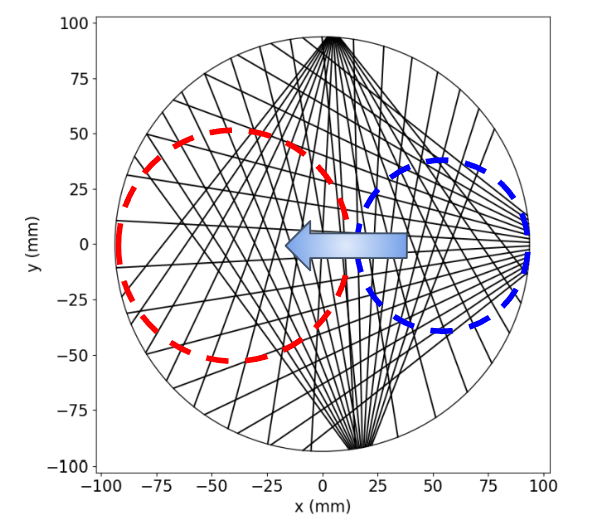
In our work on ISTTOK, we aim to transform the raw data from AXUV tomography into actionable insights by leveraging computer vision and machine learning algorithms. ML algorithms can be trained to analyse the complex data produced by AXUV sensors and other diagnostics, identifying patterns and making real-time predictions about plasma behaviour. For instance, ML could process the radiation profiles captured by AXUV to accurately estimate the plasma’s shape and position even with limited data. This capability is critical for plasma position control, which requires constant, accurate feedback to maintain the plasma’s stability and prevent disruptions. In essence, these techniques would allow for precise control of the plasma using minimal and robust diagnostics, overcoming the limitations posed by future reactor environments.
The potential of machine learning and computer vision in this area is vast. These technologies can dramatically enhance the capabilities of reduced-diagnostic systems by providing deeper insights from fewer inputs, ultimately offering a more resilient approach to plasma control. As future fusion reactors will have fewer diagnostics available due to environmental constraints, the development of ML-driven control systems could be a game-changer in ensuring safe and efficient plasma operations. The work we’re doing at ISTTOK is a critical step toward fulfilment of this vision, providing the fusion community with valuable tools and strategies to handle the challenges of tomorrow’s reactor environments.
Modelling ISTTOK Online
The digital replica of ISTTOK is available on our Fusion Twin Platform, https://fusiontwin.io/. You can model ISTTOK’s plasma via NSFsim by yourself. See our recent blog post for more information about the Platform.
We invite you to be part of this groundbreaking journey. Follow our blog, subscribe to our LinkedIn for regular updates, or reach out to us directly to discuss potential collaborations.
References
[1] H Fernandes, C.A.F Varandas, J.A.C Cabral, H Figueiredo, R Galvão, Engineering aspects of the ISTTOK operation in a multicycle alternating flat-top plasma current regime, Fusion Engineering and Design, Volume 43, Issue 1, 1998, Pages 101–113, ISSN 0920–3796, https://doi.org/10.1016/S0920-3796(98)00263-4.
[2] D. Corona et al., “Design and Simulation of ISTTOK Real-Time Magnetic Multiple-Input Multiple-Output Control,” in IEEE Transactions on Plasma Science, vol. 46, no. 7, pp. 2362–2369, July 2018, doi: 10.1109/TPS.2018.2815282.
[3] P. J. Carvalho, B. B. Carvalho, A. Neto, R. Coelho, H. Fernandes, J. Sousa, C. Varandas, E. Chávez-Alarcón, J. J. E. Herrera-Velázquez; Real-time plasma control based on the ISTTOK tomography diagnostic. Rev. Sci. Instrum. 1 October 2008; 79 (10): 10F329. https://doi.org/10.1063/1.2955854.