
DANTE: Hitting the Ground Running on a Compact Fusion Neutron Source Design
Next Step Fusion has spent the past months working as a design and engineering core team for DANTE Fusion on the conceptual design point for DANTE, a compact fusion neutron source intended for components and materials testing and for production of medical radionuclides. DANTE is built around the spherical tokamak concept, chosen for its compactness, higher achievable beta compared with conventional tokamaks [1], and the solid experimental and engineering foundation laid down by ST-40 [2] and earlier compact-neutron-source studies.
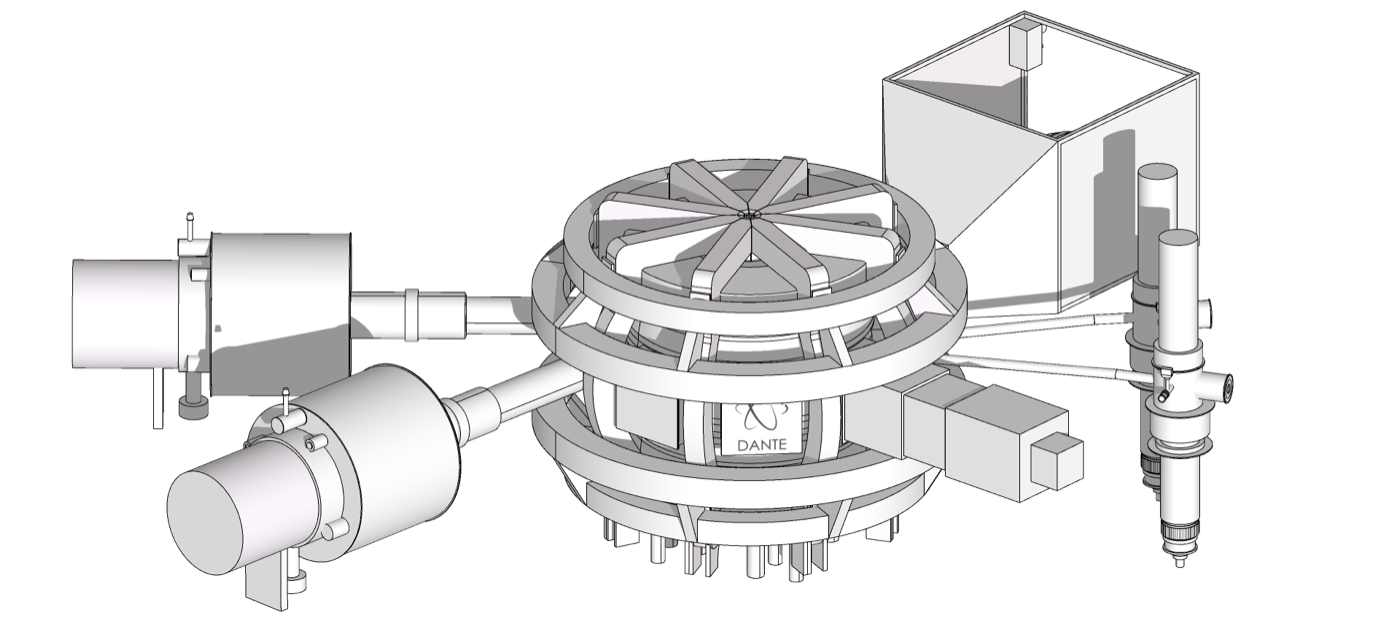
Unlike a power plant, a neutron source doesn't need to reach energy breakeven — it needs to make neutrons efficiently. That reframes the whole design problem: beam-driven fusion reactions, where a deuterium neutral beam is fired into a tritium-rich plasma, scale neutron output simply by turning up beam power, and they work at plasma temperatures and confinement levels well below what a power plant would require. That relaxation is what lets DANTE be compact, and it shaped every choice described below.
The Design Point
The present reference design targets:
- Plasma current / toroidal field: 1.5 MA / 1.5 T (at R₀)
- Major / minor radius: 0.6 m / 0.3 m (aspect ratio 2)
- Elongation / triangularity: 2.2 / −0.4
- NBI power / energy: 8–10 MW (D) at 80–120 keV
- ECRH / ICRH power: 2 MW / 2.5 MW
- Pulse duration: up to 30 minutes
- Greenwald fraction: ~0.2, well below the density limit
Materials testing needs a neutron fluence representative of real damage; isotope production needs sustained output matched to production rates and half-lives. Both push toward the same requirement: maximise pulse length. Thirty minutes of continuous operation is far outside what a typical short-pulse experimental tokamak has to handle, and it drives nearly every engineering decision in the design — active cooling for systems that in a short-pulse machine would simply be inertially cooled, and a central-solenoid flux budget that can't rely on induction alone, so plasma current is sustained mainly by bootstrap current with NBI, ECR and ICR current-drive assistance.
Why Negative Triangularity
DANTE's baseline magnetic configuration is Negative Triangularity (NT), with the X-points sitting at larger major radius than the plasma centre. Experiments on DIII-D have shown NT plasmas can reach confinement comparable to H-mode while staying in an L-mode-like edge — attractive for DANTE because it sidesteps the large type-I ELMs and transient heat loads that come with a conventional pedestal, and broader density/temperature profiles may help both beam-plasma neutron production and power exhaust. Recent SOLPS-ITER modelling [5] of NT plasmas on TCV also points to favourable divertor behaviour relative to Positive Triangularity, though the size of that benefit for DANTE's specific double-null geometry still needs to be established. The trade-off is a well-known one: NT plasmas are more sensitive to vertical instability, which is why vertical stability gets its own dedicated analysis below.
Magnets: a Compact, All-Copper System
The magnet system has four subsystems: toroidal-field (TF) coils, a central solenoid (CS), and six poloidal-field (PF) coils for position and shape control. Copper is the baseline conductor for TF, CS and most PF coils — it needs no neutron shielding, which is what makes the compact central column possible in the first place. High-temperature superconductor (HTS) coils are being considered for the outer PF coils, where shielding is easier to fit, as a future option to cut recirculating power.
Generating 1.5 T at the plasma axis calls for a current density of ~50 MA/m² in the copper central column — about 50 MW/m³ of volumetric heat generation. The TF coils are built from thick, milled copper busbar turns with cooling channels machined directly into the conductor (5×5 mm channels on a 15 mm pitch, alternating flow direction). The optimised design dissipates ~20 MW across the whole TF system, 13–14 MW of it in the central column, cooled by ~225 l/s of water, keeping the conductor temperature rise under 100 K. An eight-coil TF arrangement was chosen as the best balance between toroidal-field ripple and leaving room between coils for NBI ducts and irradiation systems — ripple comes out at ~7% on the low-field side, which ASCOT orbit-following calculations show keeps fast-ion losses within acceptable limits. The TF coils are also detachable, to allow installation and maintenance of the central solenoid and inner PF coils.
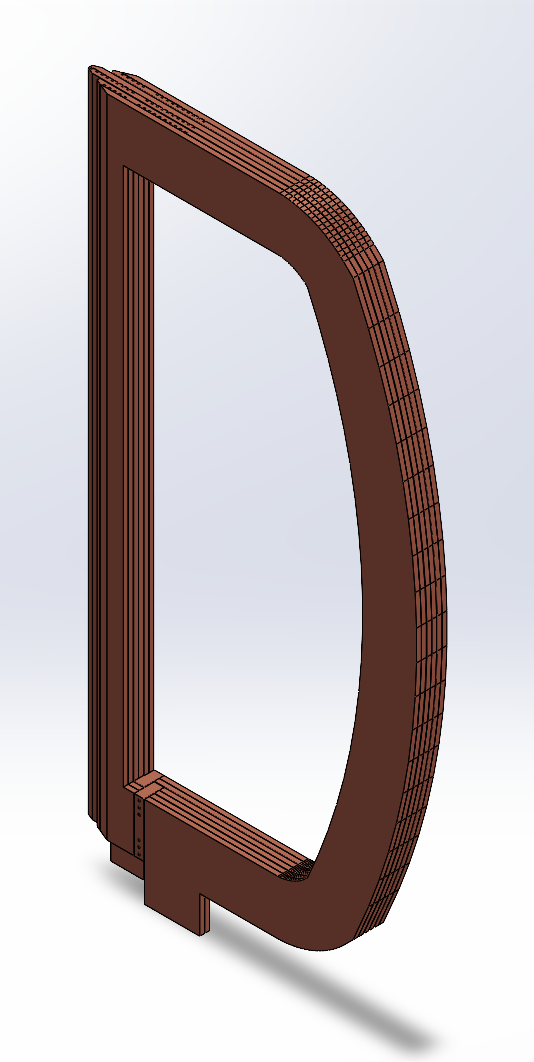
Because the TF central column and the central solenoid share the same fixed radial envelope, they can't be sized independently — thickening one heats the other. Optimising both simultaneously shrank the central-column radius from 170 mm to 155 mm and grew the solenoid's radial thickness from 35 mm to 65 mm, cutting combined dissipation by roughly 5 MW. The solenoid itself is cooled through longitudinal channels along its full 1.8 m height, split into two nested sections to add a third cooled surface and roughly halve the peak conduction path — bringing the maximum winding temperature down from 338 °C (common flow) to 261 °C with a counter-flow arrangement.
Vacuum Vessel and Divertor
The vacuum vessel is a double-wall design: a high-temperature metallic, high-Z liner, run at 600–800 °C to control plasma-facing surface conditions and recycling, inside a structural outer vessel of ITER-grade 316L(N)-IG stainless steel [6], kept at a cooler 300–400 °C to preserve its mechanical properties under irradiation. Eurofer remains a candidate alternative structural material, and more radiation-resistant materials are an option in specific locations if 316L(N)-IG can't meet the five-year vessel-lifetime target on its own. As in other spherical tokamaks, and with Double Null operation, most exhaust power is expected to go to the low-field-side divertor. In addition, even DANTE's near-vertical high-field-side scrape-off-layer leg lets the inner divertor target sit at a comparatively large major radius. Preliminary estimates suggest heat loads comfortably below engineering limits, but a firm answer including other effects of power exhaust needs integrated core-edge and divertor modelling with ASTRA and SOLPS once the final equilibrium, total power and divertor geometry are fixed.
Vertical Stability: the Price of Negative Triangularity
Negative Triangularity's known weakness is vertical instability, so this got a dedicated analysis using TokaMaker's linear Grad–Shafranov eigenvalue solver [3], cross-checked against nonlinear vertical-displacement-event simulations in our own NSFsim code [4]. With the vacuum vessel as the only conducting structure, the growth rate is above ~660 s⁻¹ — far too fast to control. Adding four copper passive stabilising plates (22 cm × 3 cm each, top-bottom symmetric, in the divertor region) brings the growth rate down to γ≈53–56 s⁻¹ against a wall time τw≈228 ms, giving γτw≈12.8. That stability margin compares favourably with SPARC and Alcator C-Mod (γτw≈4) and ITER (γτw≈1). A six-plate variant does better still (γτw≈4.4 at the lower growth rate, more precisely 17.4 s⁻¹) but was set aside because plates placed close to the central-solenoid coils consume the flux those coils generate.
The nonlinear picture is less comfortable: NSFsim simulations of the start-up trajectory show disruption in just 3–6 ms — much faster than the static eigenvalue suggests — because the current profile broadens and the halo region grows rapidly as the plasma evolves. Extending the low-field-side plate to ~33 cm pushes survival out to ~40 ms. The takeaway carried into the next design phase: even if the static passive margin looks solid, the active vertical-control system has to be specified against the full start-up dynamics, not just the flat-top eigenvalue.
From Breakdown to a 30-Minute Pulse
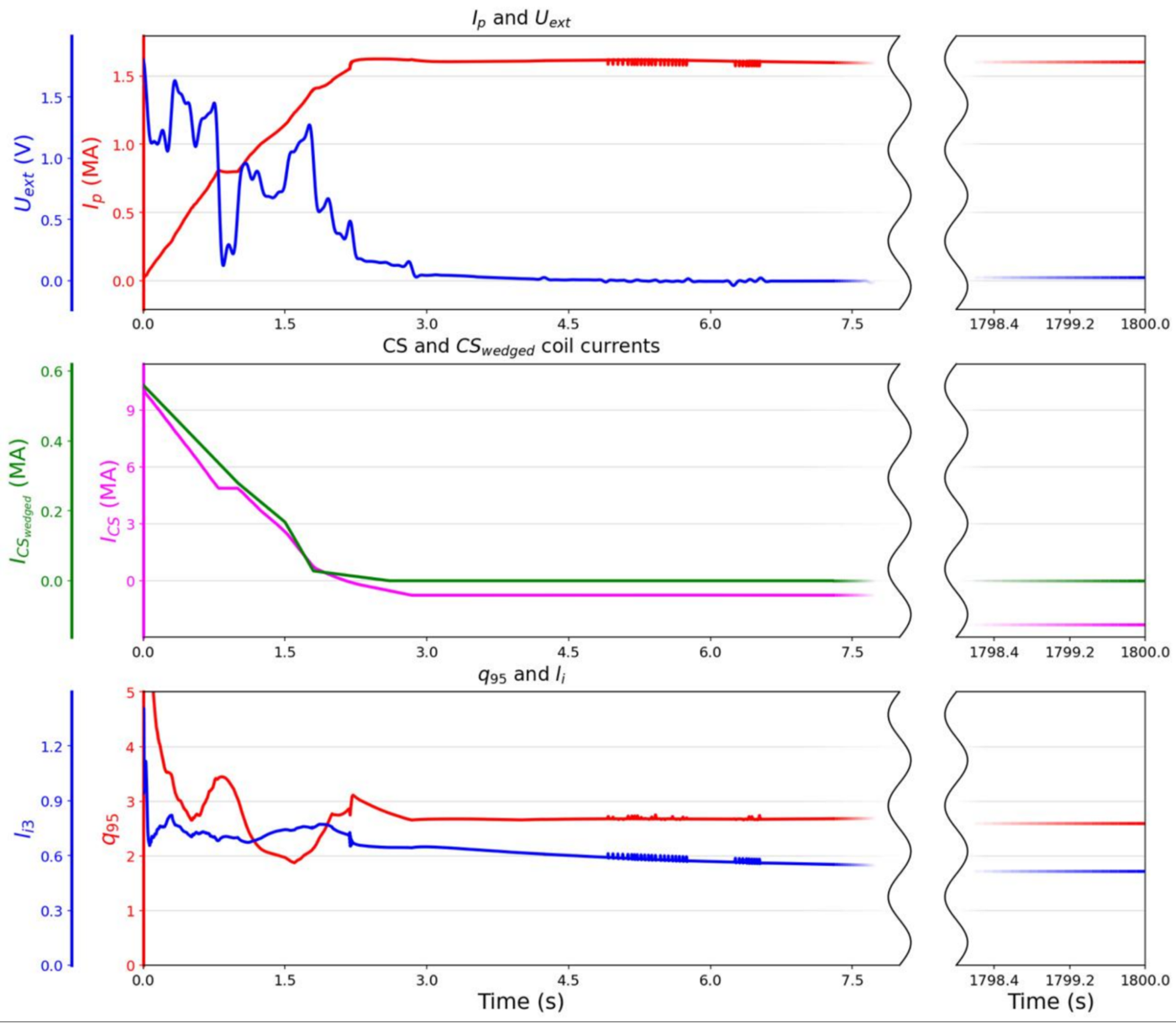
Scenario development used TokaMaker and POPCON analysis to set the steady-state target, then modelled the first ten seconds of the discharge in detail using NSFsim before extending to the full 30-minute (1800 s) pulse with fixed kinetic parameters and a variable timestep. Plasma current is deliberately ramped more slowly than a typical spherical tokamak — reaching ~1 MA in 1.2 s and full current by ~2.5 s, versus the 5–10 MA/s more commonly used — to conserve central-solenoid flux. The plasma shape evolves in stages: limited plasma, then elongation, then the Negative Triangularity shape, then the full double-null divertor equilibrium, reached within about two seconds. The full 30-minute discharge was simulated as feasible, subject to the control, thermal-management and current-drive performance actually being delivered.
Heating and Neutron Production
The baseline heating mix is 8–10 MW of neutral beam injection (deuterium, 80–120 keV) plus 2 MW of ECRH from two 1 MW, 84 GHz gyrotrons assisting breakdown, ramp-up and current profile control; a future ICRH upgrade (2.5 MW, potentially using a three-ion ICRF scenario) is also on the table. ASCOT5/BBNBI simulations of the beam-plasma reaction — a deuterium beam into a 90%-tritium plasma — show neutron production saturating above ~100 keV beam energy, with roughly 95% of neutrons coming from beam-plasma reactions rather than thermal fusion. Scaled to the 8 MW baseline, the source strength comes out at order 10¹⁸ neutrons/second, with a peak flux of about 10¹⁴ n/cm²/s achievable at a dedicated midplane irradiation port. Confirming the exact flux, spectrum and spatial uniformity at the irradiation positions is one of the priority items for the next design phase, which will need full three-dimensional neutronics.
Tritium, Safety and Irradiation Systems
DANTE's tritium throughput is modest next to a power reactor, and the reference tritium-processing technology — pellet fuelling to support peaked density profiles, getter/absorption pumping, double containment with leak detection and detritiation — is assessed as low-risk: existing systems already handle tens of grams of tritium per day at over 99.9% accountancy, well above what DANTE needs. Radiation protection, bioshield design and 3D Monte Carlo neutronics (MCNP/OpenMC/Serpent) are next-phase priorities, alongside sizing the irradiation cassettes that carry materials-testing and isotope-production samples through the neutron flux.
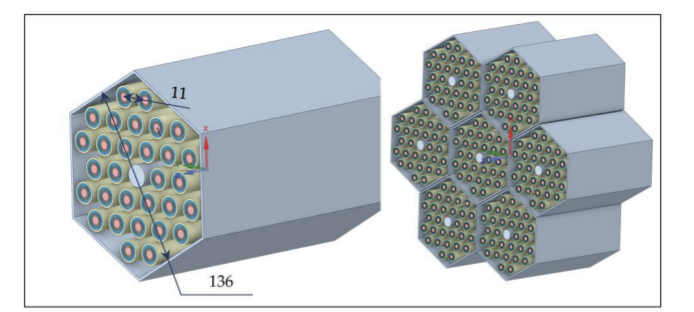
Remote handling is designed around routine cassette exchange between pulses rather than routine maintenance of activated in-vessel components, with double-loop cooling to isolate activated coolant. Detachable PF2 and PF4 coils support future replacement. A fuller remote-handling and maintenance strategy — hot-cell requirements, access routes, availability and maintainability assessment — is flagged as a next-phase item rather than settled here.
Collaboration and What's Next
DANTE deliberately avoids the highest-risk corners of the tokamak operating space: moderate plasma pressure, operation below major stability limits, and a low-recycling regime that doesn't depend on H-mode or large ELMs. Combined with relatively low fusion power, that keeps heat loads on plasma-facing components manageable and reduces disruption risk relative to power-plant-class devices. Based on the current assessment, DANTE tokamak could be designed, built and commissioned within roughly three to five years, at an estimated capital cost of €150 million — scaled from Tokamak Energy's experience with the similarly-sized ST40, adjusted for the added complexity of a fully nuclear facility, and still to be verified at the engineering-design stage.
The open items — detailed 3D neutronics, active vertical-control design, plasma-facing-component material selection, integrated 30-minute scenario modelling, remote-handling procedures — line up naturally with expertise available across the European fusion ecosystem, and DANTE Fusion is pursuing a collaboration framework with partners in that ecosystem.
We're happy to be part of the core team, working alongside DANTE Fusion's founders Prof. Dr. Volker Naulin, Dr. Mikhail Gryaznevich, Dr. Théo Verdier, and Mikkel Sørensen, and the entire DANTE team to move the project forward. Our team is proud to have hit the ground running and contributed substantially to the project's foundations, and we look forward to working with DANTE and its partners — coordinating design and engineering activities around a solid core.
Stay tuned and keep up with us by following our blog, subscribing to our LinkedIn, or contacting us to discuss collaborations.
References
[1] M. Gryaznevich et al., "Achievement of record β in the START spherical tokamak," Physical Review Letters 80(18), 3972–3975 (1998). https://doi.org/10.1103/PhysRevLett.80.3972
[2] S. A. M. McNamara et al., "Overview of recent results from the ST40 compact high-field spherical tokamak," Nuclear Fusion 64, 112020 (2024). https://doi.org/10.1088/1741-4326/ad6ba7
[3] C. Hansen et al., "TokaMaker: An open-source time-dependent Grad-Shafranov tool for the design and modeling of axisymmetric fusion devices," Computer Physics Communications 298, 109111 (2024). https://doi.org/10.1016/j.cpc.2024.109111
[4] R. Clark, M. Nurgaliev, E. Khairutdinov, G. Subbotin, A. Welander, and D. M. Orlov, "Validation of NSFsim as a Grad-Shafranov equilibrium solver at DIII-D," Fusion Engineering and Design 211, 114765 (2025). https://doi.org/10.1016/j.fusengdes.2024.114765
[5] F. Mombelli et al., "Impact of triangularity on edge transport and divertor detachment: a SOLPS-ITER study of TCV L-mode plasmas," Nuclear Fusion 65(10), 106012 (2025). https://doi.org/10.1088/1741-4326/ae00d9
[6] G. M. Kalinin, B. S. Rodchenkov, and V. A. Pechenkin, "Specification of stress limits for irradiated 316L(N)-IG steel in ITER structural design criteria," Journal of Nuclear Materials 329–333, 1615–1618 (2004). https://doi.org/10.1016/j.jnucmat.2004.04.140
[7] P. Pereslavtsev, C. Bachmann, J. Elbez-Uzan, and J. H. Park, "Potential of Radioactive Isotopes Production in DEMO for Commercial Use," Applied Sciences 14(1), 442 (2024). https://doi.org/10.3390/app14010442