Investing in Tomorrow: A Look at Fusion Energy Investment Landscape
The fusion energy sector has experienced significant growth in investments over the recent years, signaling growing confidence in its potential as a sustainable energy solution. Both private investors and government funds have contributed to this growth, demonstrating optimism and a strategic focus on advancing fusion technologies.
In this article, we explore key trends in fusion energy investments, analysing the distribution of funding across various technological approaches, profiles of key investors, and investment patterns shaping the future of fusion energy.
About the Data
The insights presented in this article are based on a comprehensive analysis of available investment data from 2000 to 2025, focusing on 41 companies that raised funding during this period. To better understand the distribution of investments, we categorized fusion approaches into the following key groups:
- Magnetic Confinement Fusion (MCF): This category includes well-established Tokamaks and Stellarators, along with innovative configurations such as Field-Reversed Configuration (e.g., TAE Technologies), Magnetic Mirror, and Levitated Dipole (e.g., OpenStar Technologies).
- Inertial Confinement Fusion (ICF): This approach includes laser-driven methods (Xcimer, Marvel Fusion) and shock-driven techniques (First Light Fusion) to compress and heat fusion fuel.
- Magneto-Inertial Fusion (MIF): A hybrid of magnetic and inertial confinement methods, MIF includes Field-Reversed Configuration [Pulsed] devices (e.g., Helion Energy), Magnetized Target Fusion (e.g., General Fusion), Magnetized Liner Inertial Fusion (e.g., Fuse), Z Pinch, Pulsed Magnetic Fusion (e.g., Pacific Fusion), and emerging innovations like Space Propulsion (e.g., Helicity Space).
- Hybrid Electrostatic Approaches: Magnetic electrostatic configurations with main representatives: Shine Technologies, Avalanche.
- Muon-Catalyzed Fusion: A niche but intriguing approach, represented by Acceleron Fusion, which explores the potential of using muons to catalyze fusion reactions under less extreme conditions.
- Other: This category includes companies like Kyoto Fusioneering, which develop confinement-agnostic technologies, such as integrated fuel cycles, thermal systems, and advanced plasma heating systems.
About Us
Next Step Fusion is a Luxembourg-based software development and machine learning company dedicated to advancing fusion energy through software development, machine learning, and AI-driven solutions. We offer advanced simulations, tokamak design and optimization, plasma control systems, and digital twin technologies — all essential for accelerating the commercialization of fusion.
As a company deeply involved in the fusion ecosystem, we recognize that funding shapes the pace of technological progress. Investment flows determine which approaches advance, which technologies are gaining momentum, and how fast fusion can transition from research to commercial reality. By analyzing investment patterns, we gain deeper insights into market dynamics, emerging opportunities, and the evolving priorities shaping funding decisions.
As a company working at the crossroads of AI, plasma control, and simulation, we actively seek to connect with startups, innovators, and investors who share the vision of accelerating fusion development and fostering partnerships that drive progress in the field.
Investment Trends: Distribution by Approach
Since 2020 total investments in fusion energy reached an impressive $7.8 billion, with private investors contributing $7.2 billion and public grants providing $600 million. This represents a significant portion of the $9.4 billion invested in fusion energy since 2000.
These numbers highlight the growing confidence in fusion’s potential as a transformative energy source. The strong involvement of private capital indicates a shift towards commercial readiness, while public funding continues to play a critical role in supporting early-stage research and technological breakthroughs. Together, these investments underscore the industry’s transition from experimental science to a viable energy solution.
Notably, 2021 marked a record-breaking year, with CFS raising $1.8 billion and Helion Energy securing $500 million in funding rounds. These deals signaled the beginning of a new era where the private sector emerged as a key driver of fusion technology development.
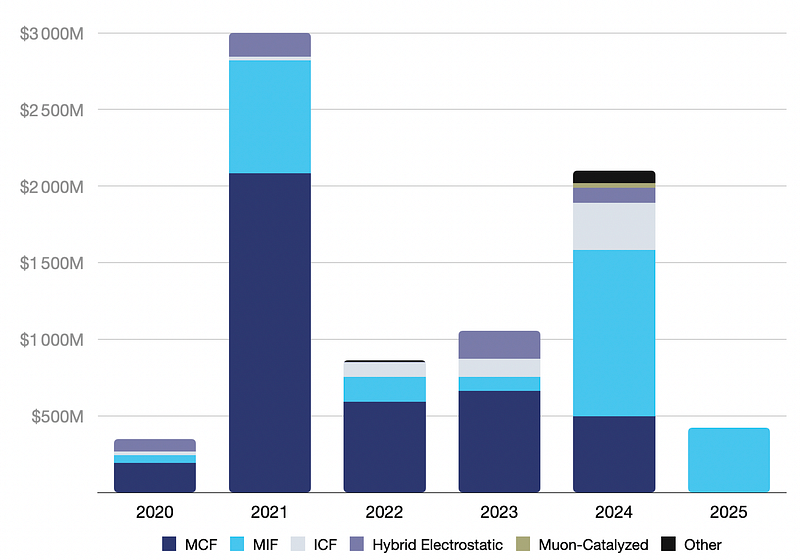
The dominance of MCF in investments was driven by recent advancements in high-temperature superconductors and improved plasma confinement. This has led to consistent growth in MCF funding, reflecting investor confidence in its potential as the most viable path toward the commercialization of fusion energy.
There is a clear link between technological progress and investment trends. Each milestone, from JET’s energy record to W7-X’s extended plasma performance and NIF’s energy breakthrough, acts as a catalyst, bringing renewed attention and confidence to the fusion technology. These successes demonstrate progress toward commercial viability, which is a key factor for investors seeking tangible outcomes and scalability. Additionally, as private-sector players continue to showcase prototype results, sustain plasma performance, and develop critical enabling technologies (e.g., HTS magnets), investor interest continues to diversify across approaches.
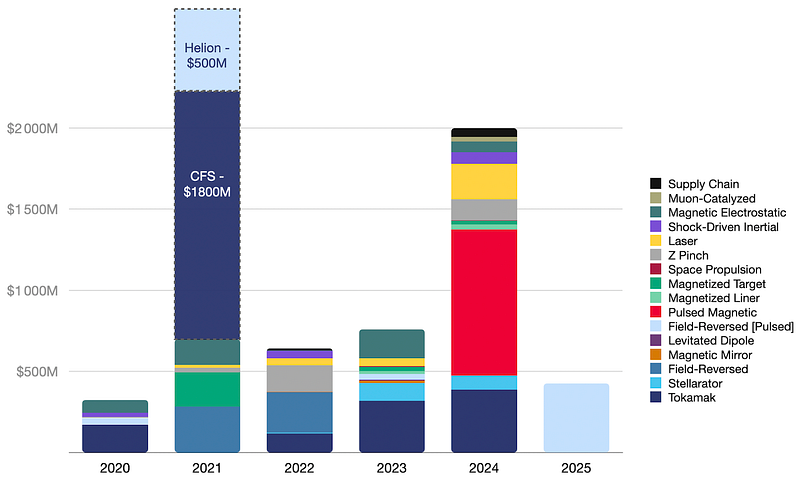
2021 was a standout year with few but high-value deals (CFS $1.8B, Helion Energy $500M). Post-2021, investment activity shifted towards a growing number of deals, with an increase in new companies entering the market, though many remain early-stage with smaller check sizes, reflecting market expansion.
- Tokamaks: As the most promising and reactor-relevant technology, tokamaks consistently lead in investment due to their strong track record of scientific progress. Stable funding for tokamaks has been bolstered by key achievements, such as JET’s energy release record, EAST’s extended plasma performance, and the presentation of a high-temperature superconducting magnet with a field strength of 20 Tesla by CFS.
- Stellarators: Rising investments in stellarators after 2023 can be directly attributed to the groundbreaking results of the W7-X experiment in February 2023. The device demonstrated a new milestone, achieving a power plasma with gigajoule energy turnover sustained for eight minutes. This success revitalized interest in stellarators, highlighting their potential as an alternative to tokamaks for achieving stable and efficient plasma confinement.
- Laser: This approach has gained significant attention thanks to key milestones achieved by the National Ignition Facility (NIF). In August 2021, NIF generated 70% of the input energy, and in December 2022, it achieved a groundbreaking record by demonstrating net energy gain from laser fusion for the first time. These breakthroughs have put laser-driven technologies in the spotlight, boosting the emergence of new startups and attracting significant investor interest.
- Z Pinch: Simplified designs and lower costs have made Z Pinch (e.g., Zap Energy) increasingly attractive, diversifying the investment portfolio.
While 2021 set records for funding amounts, 2023 and 2024 saw a record number of deals reflecting broader investor interest and greater diversification across fusion technologies. The year 2024 also saw a landmark deal, with Pacific Fusion (USA) raising $900 million — the second-largest funding round in the fusion energy sector to date (after CFS). This diversification of investment highlights the sector’s growing maturity. While tokamaks dominate, rising interest in stellarators, laser-driven fusion, and other innovative approaches shows that investors are exploring multiple paths to achieve fusion’s promise.

The steady growth in investment deals from 2020 to 2024 was driven by technological breakthroughs and regulatory support, all of which increased investor confidence. The diversification of funding across multiple fusion approaches reflects the entry of new startups and significant experimental milestones, including NIF’s energy gain record (2022), JT-60SA’s first plasma (2023), W7-X’s extended plasma operation (2023), TAE’s hydrogen-boron fusion experiments (2023), WHAM’s first plasma in mirror fusion (2024), the first plasma in a levitated dipole device (2024), etc.
Who’s Fueling Fusion: Investors Profile
It’s not just the number of deals is growing, the pool of investors supporting fusion has expanded significantly. Venture capitalists, institutional funds, industry corporations, and high-profile philanthropists are increasingly entering the sector, making the investment landscape more dynamic and competitive. Each group brings unique motivations and strategies to their involvement in the sector.
In 2024 alone, over 140 investors participated in deals across 23 fusion companies, with more than 80 new investors entering the field. This pushed the total number of investors past 500, reflecting growing interest and confidence in fusion as a key energy solution.

Investor participation and capital raised in fusion have been steadily growing since 2020. While 2021 saw a major funding spike, driven by a few large investments, the number of investors and funded companies steadily increased in the following years. More than 530 private investors contributed $7.2 billion since 2020, demonstrating an increasingly competitive investment sector.
Notable investors:
- Venture Capital Funds: Breakthrough Energy, Khosla Ventures, Starlight Ventures, Lowercase Capital, and Tiger Global Management are among the most active players, supporting companies like CFS, Zap Energy, Xcimer and Thea Energy.
- Governmental and Institutional Investors: Public funds remain critical to advancing fusion research. Institutions like the Business Development Bank of Canada, which supports General Fusion, and the European Innovation Council Fund have provided grants to Marvel Fusion and Proxima Fusion. Germany’s BMBF also supports domestic startups with research grant initiatives.
- Industry Corporations: Industry leaders such as Google, Honda, and Mitsubishi have made strategic investments, reflecting their confidence in fusion’s transformative potential and its alignment with their broader sustainability goals.
- Niche Investors and Tech Billionaires: High-profile figures like Bill Gates, Jeff Bezos, and Sam Altman have emerged as key supporters, funding startups such as CFS, Helion, and General Fusion. Their involvement brings additional visibility and credibility to the sector.
Fusion investment patterns present a growing appetite for various technologies. Venture capitalists tend to focus on scalable and commercially promising concepts, while institutional funds often prioritize early-stage research or proof-of-concept through grants. Industry corporations seek synergies with their existing capabilities, such as Google’s interest in computational modeling or Nucor’s focus on decarbonizing industrial manufacturing. Meanwhile, niche investors are drawn to bold, transformative ideas, often funding projects that push the boundaries of traditional approaches.
A deep look at investor participation across different fusion technologies shows a diverse and balanced portfolio with no single technology front-runner. Instead, the data shows a wide array of investors supporting multiple approaches and participating at different stages of development. Notable players like Lowercarbon Capital, Breakthrough Energy, and Chevron Technology Ventures are highlighted for their broad engagement in various fusion concepts, ranging from tokamaks to innovative approaches like Z Pinch and hybrid electrostatic systems.
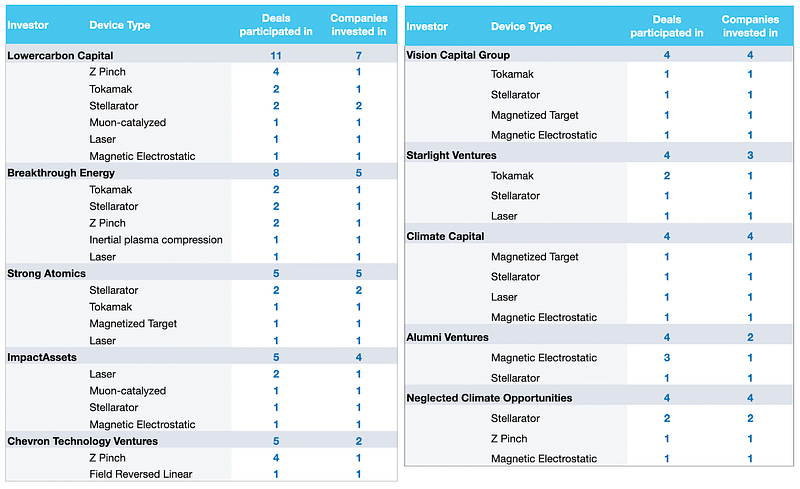
This distribution of investments indicates a sector-wide belief that no single approach holds all the answers. Tokamaks may lead in maturity, but the increasing interest in newer concepts highlights the market openness to diverse solutions. By collectively supporting multiple technologies, investors are driving progress across the entire sector, rather than focusing on a single approach.
At Next Step Fusion, we recognize the importance of technological diversity in fusion energy development. However, we remain focused on MCF, particularly on tokamaks, because they represent the most scientifically validated and scalable approach. Tokamaks have already demonstrated net energy production (JET), long-pulse plasma operation (EAST), and high-temperature superconducting magnets (CFS), which are critical steps toward commercialization. While we closely monitor and analyze investments in alternative approaches, we believe that advancing tokamak technology, improving plasma control, and integrating AI, ML solutions for device design and optimization will accelerate the path to grid-ready fusion energy faster than other concepts.
Leading in Investments: Key Players and Success Factors
Currently, the fusion industry is defined by a select group of companies that have successfully attracted the highest levels of investment, showcasing their ability to demonstrate progress and inspire confidence among investors. Nine standout companies, including CFS, TAE Technologies, Pacific Fusion, Helion Energy, Neo Fusion, ENN, Tokamak Energy, General Fusion, and Zap Energy, collectively account for approximately $7.1 billion of the $9.4 billion invested in fusion to date.
An analysis of their journeys highlights several critical factors that have enabled them to secure substantial investments and maintain their leadership in the sector:
- Progress in product development: Companies demonstrating clear progress in device construction or advancements in their technology gain credibility and attract more funding.
- Collaborations: Extensive partnerships with researchers and institutions enhance technical capabilities and lend scientific legitimacy.
- Customer engagement: Early-stage engagement with potential end users, such as energy utilities or industrial players, signals market readiness.
- Intellectual property: Scientific publications, patents, and proprietary technologies signal innovation and protect market positioning.
- Visibility and leadership: Having high-profile team members, participation in accelerator programs, and active representation at topical conferences ensure visibility and help companies gain investor trust.
Their success lies in their ability to deliver measurable progress while maintaining strong communication and reporting to stakeholders. This highlights an important trend in the fusion energy sector: securing investments is not just about technological potential but also about demonstrating a clear pathway to product usage in the market and commercialization.
The Road Ahead
Fusion energy remains a high-stakes investment arena, driven by technological progress and the promise of a clean, abundant energy future. With advancements in regulatory frameworks, such as the ADVANCE Act in the USA, Energy Act 2023 in the UK, and China’s national nuclear fusion regulations, the path to commercialization is becoming clearer. This growing government support, combined with breakthroughs in fusion technology, is boosting investor confidence and driving greater interest in the sector.
As we look to the future, fusion energy is entering a pivotal phase. The increasing number of deals and expanding investor participation signify the sector’s transition from niche research to a competitive and diverse marketplace, attracting a mix of established players and innovative newcomers. With no clear technology winner yet, the fusion investment ecosystem remains dynamic and inclusive, ensuring that promising ideas from all corners of the sector can receive the support they need to move forward. As more players enter the market and funding continues to diversify, the next decade could mark the transformation of fusion energy from groundbreaking research to commercial reality, delivering on its promise to redefine the global energy landscape.
We invite you to be part of this groundbreaking journey. Follow our blog, subscribe to our LinkedIn for regular updates and newsletter, or reach out to us directly to discuss potential collaborations.