Next Step Fusion Negative Triangularity Tokamak Conceptual Design
In a previous article, we described why Next Step Fusion is interested in the Negative Triangularity approach. Now, we’d like to introduce the Next Step Fusion Negative Triangularity Tokamak (NSF NTT), a private research device which we design for testing our ML-based Plasma Control System in extreme conditions (e.g., potentially disruptive scenarios), as well as for experiments related to Fusion Power Plants (e.g., weak actuators, data-poor diagnostics, and power handling). We are also exploring the idea of offering time and device resources to external experimental scientists, a concept we refer to as “Tokamak-as-a-Service”.
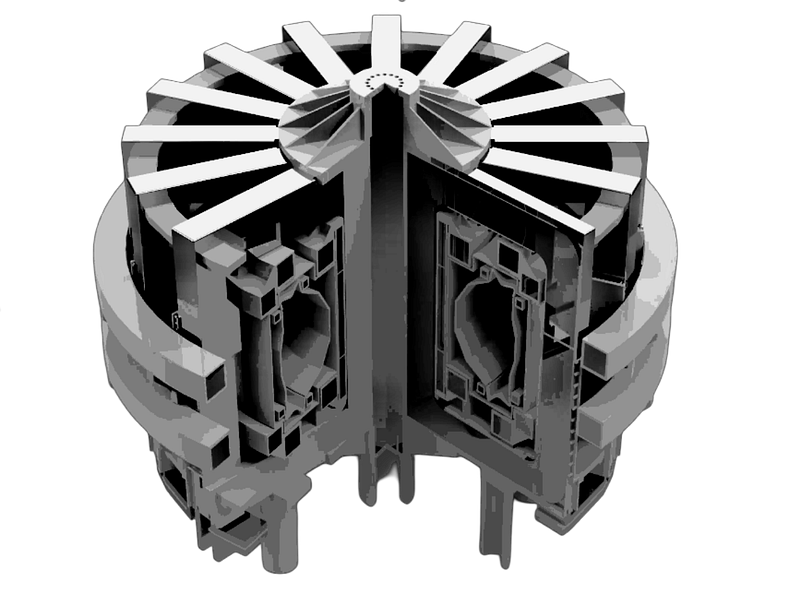
The first step in designing any fusion device is to define its key parameters, which are determined by the purpose of the study (interest of the scientific community), available funding, and cost optimization. Since we have defined Negative Triangularity (NT) as a target magnetic configuration, the next step is to define the main geometric parameters, such as the major (R) and minor (a) radii (or aspect ratio A=R/a), as well as the main parameters of the magnetic system, such as the toroidal magnetic field strength (Bt) and the target plasma current (Ip). Target discharge length (td) depends on the design of the power supply of the machine and the type of magnetic system coil wire material.
The optimal choice for NSF NTT magnetic system coil wire material is water-cooled copper, which will make the machine design less expensive and simpler, but it allows us to achieve the required parameters of the magnetic field and control speed. In order to make maintenance and component replacement easier, we have designed dismountable TF coils with opening at the top cover of the vacuum vessel. This feature will help to simplify upgrading or replacing the vacuum vessel if needed, since we are going to operate NSF NTT in extreme conditions.
In terms of size and cost optimization we can consider three options: small, medium and large sized machines. All these options have pros and cons and we should define which option will be optimal for NSF objectives.
The idea of building a small machine may be attractive because of the short production period and its low cost. Which means one can test hypotheses quickly and without large losses of invested funds. But the small size machines also have some disadvantages. Usually, small machines can not achieve high plasma parameters. The vacuum vessel wall primarily stabilizes plasma in small machines, not the active control. Besides, integration of large amounts of diagnostics and additional heating systems can be a problem. These aspects make small machines irrelevant for global goals of NSF research.
In contrast, large machines provide the means to achieve reactor-relevant plasma conditions in terms of both plasma parameters and stability. However, they require much larger investments, a long design and production process. Roughly speaking, the amount of required investments rises approximately as a cubical function of the machine characteristic linear size.
The amount of energy necessary for the operation is also increasing rapidly with the size of the machine, which may require hundreds of megawatts. When the grid power capacity is limited, the only way to provide power is by buffering it. This can be done using a flywheel generator, battery storage, or capacitive storage. These devices can store energy slowly between pulses and then provide the peak power required during a pulse. Parameters of the power supply should match the load requirements (coil cross-section and operating time). Energy density and power density are also important parameters for choosing the basic power supply element.
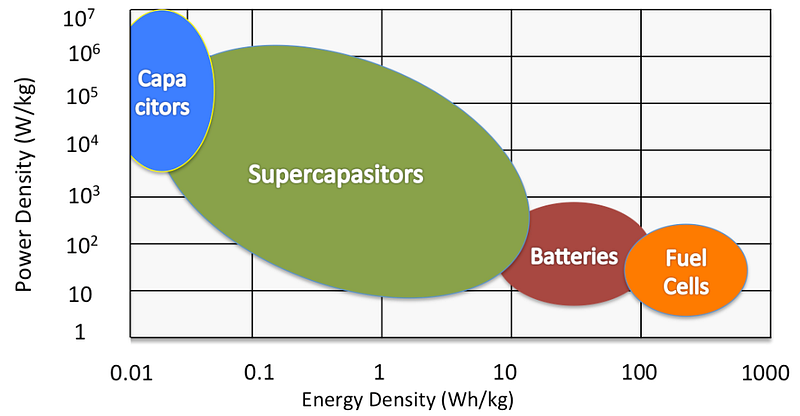
The flywheel generator is highly effective, has excellent energy storage capability, but high cost, mechanical and operational complexity offset the advantages. Supercapacitor cells have proven to be the ideal choice for a power supply’s fundamental component. They possess characteristics that lie between batteries and traditional capacitors, striking a balance in terms of both energy density and power density. The main disadvantages of supercapacitors are self-discharge and higher initial cost. So not only the machine itself will be expensive but also the power supply for the magnetic system.
On top of that, there are other reasons why a large-sized machine is not optimal for NSF. The logistics of separate parts to the machine site becomes more complicated, the number of staff increasing significantly. Also there are well equipped public machines with bigger size which may be adapted to Negative Triangularity configuration (e.g. DIII-D [2], ASDEX Upgrade [3]).
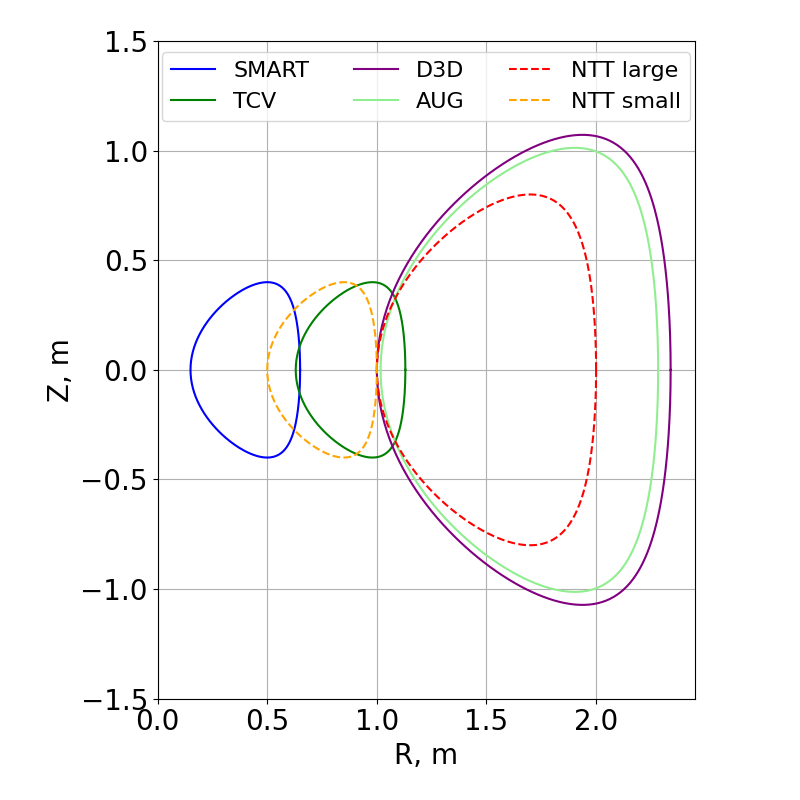
With that said for NSF objectives the medium-size machine is the optimal choice. So the major radius R should be in the range from 0.75 m to 1.5 m. From [4] we know that aspect ratio A for NTT should be bigger than 3. Accordingly, minor radius a should be in the range from 0.25 m to 0.5 m. Reducing the aspect ratio also presents challenges in the engineering integration of the central solenoid, making higher values of A more preferable. For a size comparison with existing machines, please refer to Figure 3, which shows the contours of the last closed flux surfaces at specified values of elongation and triangularity.
Next, we need to define the toroidal magnetic field strength Bt and the target plasma current Ip for the device. Based on general considerations, one can set the lower limits for these parameters as Bt = 1 T and Ip = 500 kA. It would not be an exaggeration to say that devices with lower parameters are not of great interest to the fusion community. On the other hand, too ambitious values of Bt and Ip for the medium-sized device will require oversized coils of magnetic system which will not allow integrating all the needed equipment around the device. As the upper limit is determined based on engineering constraints (heating, strength, size), one may set Bt = 3 T and Ip = 1 MA, which make NSF NTT interesting for the fusion community providing not only a broad field for the NT physics exploration but also a space for reactor-relevant experiments.
The magnetic system initiates long before plasma breakdown. This involves ramping up the currents in toroidal coils and central solenoid to the target values over a period of 2 seconds. Additionally, initiating the plasma and ramping it to the full-power configuration (with the plasma current about 1 MA) will take an additional second. The optimal length of the plasma current flattop should be from 1 to 5 seconds. Having more flattop time allows us to offer more service to external users. The current ramp down stage requires about 1 second. Yet, the coil’s heating limit constrains the length of the pulse during operation. In addition, the longer the pulse, the larger and more expensive the power supplies based on expensive supercapacitor banks become. Taking these factors into account, we have preliminarily chosen a discharge length td ≤ 10 seconds.
Thus, we have determined the key parameters of our machine and began a preliminary design based on them. We will provide more details in one of our next posts.
Stay tuned and keep up with us by following our blog, subscribing to our LinkedIn, or contacting us to discuss collaborations.
References
[1] M. Winter and R. J. Brodd, “What Are Batteries, Fuel Cells, and supercapacitors?” Chem. Rev. 104, 4245 (2004)
[2] K E Thome et al 2024 Plasma Phys. Control. Fusion 66 105018
[3] L Aucone et al 2024 Plasma Phys. Control. Fusion 66 075013
[4] A Balestri et al 2024 Plasma Phys. Control. Fusion 66 075012