NSFsim
This is the first post of our tech blog, and it’s intentionally about our simulator.
Next Step Fusion Simulator, or simply NSFsim, is foundational to everything we do. Our teams leverage it for myriad purposes, including simulation, experiment planning, analysis, and research. Beyond these applications, NSFsim plays a crucial role in training machine learning (ML) models designed for plasma control and behavior prediction. By simulating complex plasma behaviors and dynamics, it provides an essential environment for developing advanced control systems.
NSFsim is built on renowned approaches developed for the DINA code, a proven method for modeling the intricate behaviors of plasma in tokamaks. Its code is written in Fortran because it offers high-speed computation for mathematical abstractions. Fortran is efficient in scientific computing and optimized for mathematical operations and data sets. It was chosen for its ability to process complex calculations quickly, which is crucial for large data sets and detailed mathematical models.
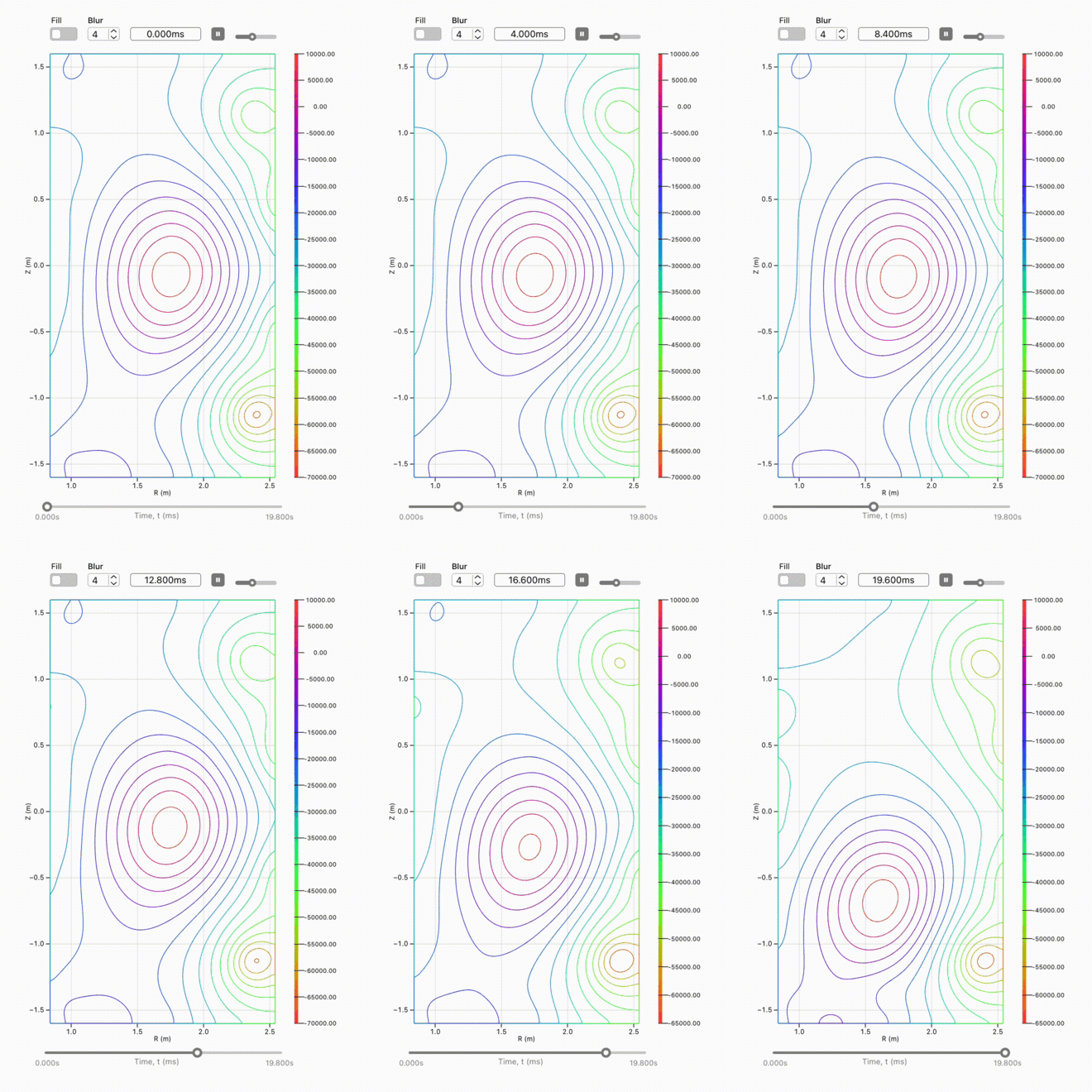
NSFsim is a flexible and fast control-oriented tool. It has been used in full-discharge simulation, scenario development, and vertical displacement event analysis. It solves the evolution of fixed and free-boundary 2D plasma equilibrium (Grad-Shafranov equation) together with external circuits, such as the poloidal field coils and surrounding conducting structures. The coupling between equilibrium and transport is based on an iterative scheme.
Solving all the equations together in a self-consistent manner requires the introduction of a mathematical abstraction of real devices. We call it a configuration. It is a digital replica that is unique for each tokamak. The starting point to create a configuration is to set the geometrical and electrical characteristics of a magnetic system and passive conducting structures. The calculation domain is represented by a mesh that can differ for each element.
Another important step is defining diagnostics. For plasma shape and position control, magnetic diagnostics such as magnetic probes and flux loops are essential. Synthetic signals of those sensors are calculated considering the mutual magnetic fields arising from toroidal currents in plasma, active, and passive elements. Other control tasks require different synthetic sensors that can be easily integrated into NSFsim thanks to its modular structure.
Each configuration undergoes meticulous calibration and rigorous validation against experimental data. We utilize sophisticated tools and scripts to craft these configurations with precision. Given the evolving nature of tokamak setups, we ensure each configuration has a self-explanatory name, a detailed description, and versioning to track changes over campaigns.
Validation does not stop at the initial configuration. We conduct further validation through reference shots, comparing our simulations with actual experimental outcomes to ensure accuracy. This iterative process of comparison and refinement guarantees that our digital twins remain precise and reliable.
This approach allows us to simulate the intricate details of plasma physics, magnetic fields, energetics, and control mechanisms. By considering factors such as thermal conductivity, compression, and electron drift, NSFsim can accurately predict plasma evolution and solve reverse tasks, providing a comprehensive understanding of tokamak operations.
Our collaboration with facility teams extends beyond validation. We share our learnings and incorporate feedback to continuously refine and enhance our digital replicas. This collaborative approach ensures that NSFsim remains at the cutting edge of tokamak simulation technology.
NSFsim is more than a simulator; it is a critical tool that drives our research, development, and operations in the fusion industry. By providing accurate simulations and fostering collaboration with tokamak facilities, NSFsim helps pave the way for advancements in fusion technology. Our commitment to continuous improvement and validation ensures that NSFsim remains an indispensable asset in the quest for sustainable and controlled fusion energy.
Stay tuned for more updates and insights into our groundbreaking work with NSFsim and other innovative technologies in the fusion industry.