Reinforcement learning for tokamak scenario development and multi-objective optimization
When we run a tokamak experiment, we want the plasma state to follow a planned trajectory. Designing a discharge scenario means working out how to guide the plasma along that trajectory while staying within the machine’s operating limits. To date, discharge scenario design requires specialist expertise and a lot of attempts. A typical workflow involves defining the target plasma state and then simulating the discharge by trying several different actuator waveforms, adjusting controller setpoints, and reviewing the resulting plasma performance. Changes in plasma current, density, or magnetic configuration often require additional tuning of the control system. This becomes particularly challenging when the scenario includes transitions between different plasma configurations or when several competing performance objectives must be satisfied simultaneously.
We’re now developing a machine learning tool within our integrated modeling suite to make this task compute-intensive rather than expertise-intensive. We propose to replace the iterative trial-and-error approach with a single goal-conditioned model trained using a tokamak simulation environment. Using this tool, the scenario designer specifies the desired evolution of physical quantities: plasma current (Ip), line-averaged electron density (⟨ne⟩), and the shape of the plasma last closed flux surface (LCFS). After that, the controller determines the actuator commands required to follow these targets within the prescribed plasma (for example, safety factor) and engineering (for example, coil currents) limits.
Scenario design as a control task
We apply reinforcement learning (RL) methods to discharge scenario development. The model is a controller that takes the current plasma and device state along with the target parameters and outputs the actuators' values, one time step per model call. This model is trained using a tokamak simulator and does not require a dataset. Instead, the data is generated during training. In a sense, the trial-and-error process is performed “in advance”. The resulting model can provide a scenario for any target plasma configuration within the sampling region, given that the target is feasible and reachable. The RL process uses a single numerical optimization objective, the reward, which the RL algorithm maximizes. We therefore bundle all the targets into a single metric, a number between 0 and 1.
As a showcase, we applied the method to a double-null (DN) target state for the EAST tokamak. In our setup, the training environment is our NSFsim for MHD and transport evolution, coupled with ASCOT5 for NBI modeling. The controller operates with a 1 ms time step.
Ohmic scenario development
In the ohmic scenario, the controller model outputs are the coil currents and the neutral gas fueling rate. Since we want the scenario to reach multiple objectives, the reward has several components:
- Objective accuracy: plasma current, density, plasma center, and plasma boundary (LCFS) shape
- DN mode forcing: X-point flux imbalance
- Engineering constraints: maximum difference between the six CS coil currents, and PF coils' saturation
The components are then mapped to the [0, 1] range and bundled into a single value close to their minimum. This setup ensures that the training algorithm maximizes all the components.
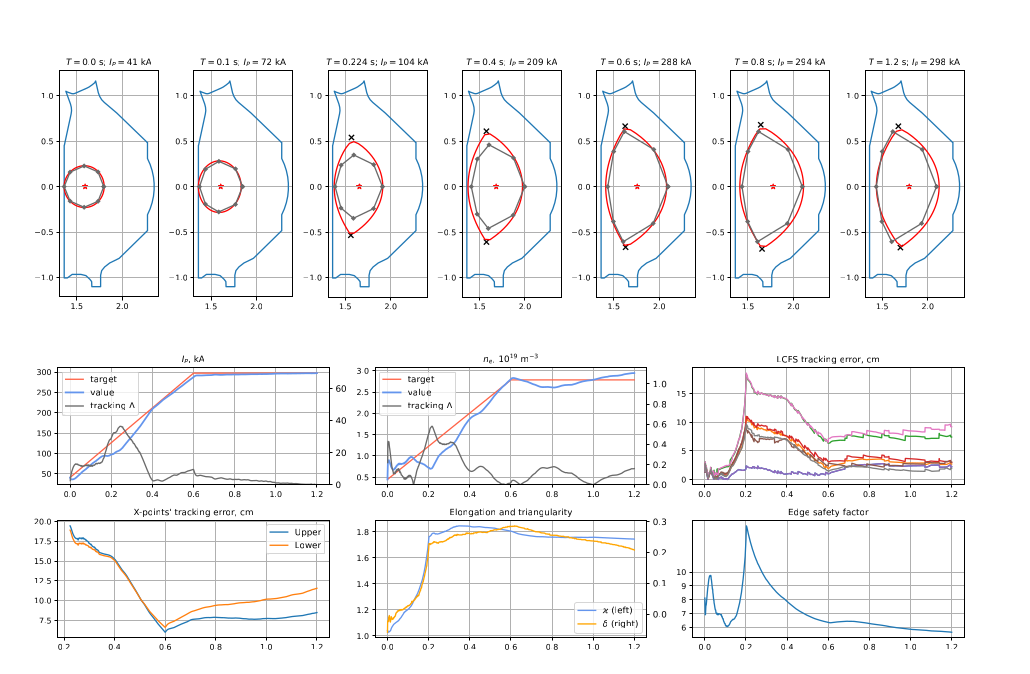
We trained the controller across a range of target scenarios with target plasma currents of 200–350 kA, densities of 1.5–3.0 × 10¹⁹ m−3, elongations of 1.7–2.0, and minor radii of 0.24–0.36 m.
Rather than prescribing the time of the transition to diverted operation or switching between separate controllers, the RL policy learns to establish the X-points and detach the plasma from the limiter while continuing to track the evolving scenario targets. To encourage this, we introduced the concept of phases. Each discharge is split into two phases. It starts in phase 0 and moves to phase 1 once the plasma has sustainably passed the limiter-to-divertor transition. The phase number (0 or 1) is added to the control accuracy reward.
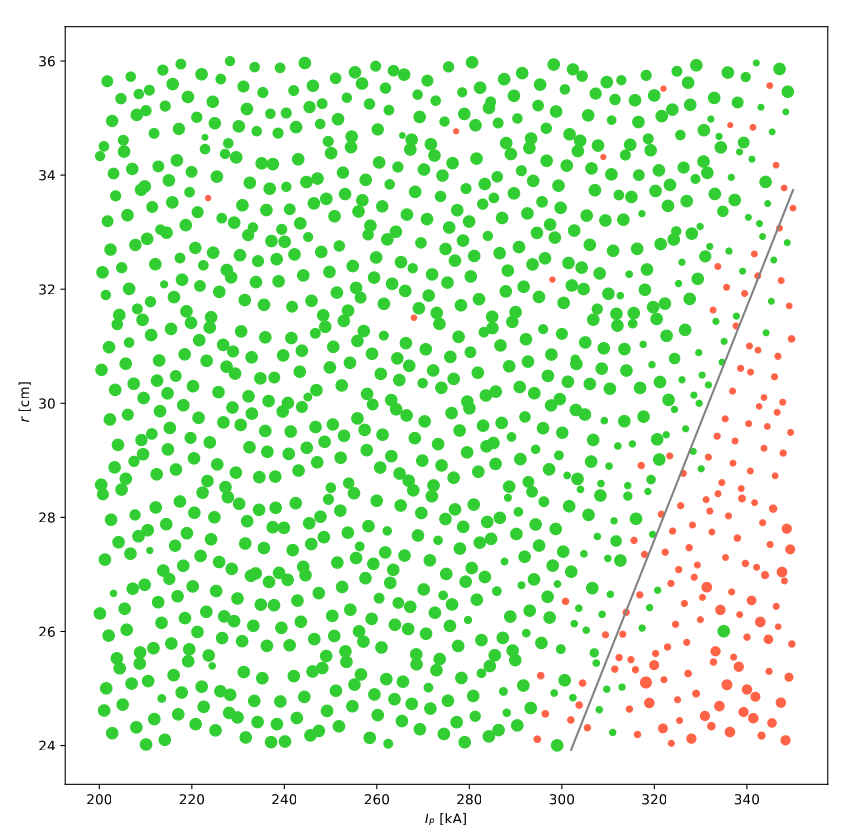
To evaluate the range of achievable scenarios, we tested the trained model on 1,024 target combinations sampled to evenly cover the 11-dimensional parameter space.
The results were:
- 86% of scenarios successfully reached diverted operation.
- 77% maintained the diverted configuration for at least 0.1 s.
- 67% maintained it for at least 0.5 s.
- 58% remained diverted until the end of the 1.2 s simulation.
We see this not as a measure of controller performance, but rather as a map of the region of target space in which the trained controller can construct feasible scenarios under the assumptions of the simulation model.
As we observed, this region is a linearly separable subset of the 11-dimensional operating space that depends strongly on the requested plasma current and minor radius.
Extension to heating and current drive
The next step was to introduce auxiliary heating and current drive (H&CD) into the same scenario development framework.
In the extended environment, the RL agent additionally controls the total auxiliary heating power (an additional model output).
To encourage steady-state operation, we also introduce an additional reward component and a new shot phase. The new reward component is the absolute value of the loop voltage. Loop voltage going toward zero means the shot moves to fully non-inductive plasma current control, which allows for long pulses. The new phase (number 2) starts when we turn the heating on and start controlling the loop voltage. After the transition, the loop voltage is included in the smooth-min reward and heating control is enabled.
Increasing auxiliary power reduces the inductive contribution required to sustain the discharge, but also increases driven current and modifies the electron temperature and current-density profiles. These changes affect the equilibrium and can interfere with the original plasma current and shape targets. The controller must therefore find a compromise between reducing loop voltage and maintaining the requested Ip while keeping the magnetic state stable.
The extended controller was trained using 1.2-second episodes and subsequently evaluated on longer discharges, testing its behavior beyond the training horizon. The controller established a double-null diverted configuration at approximately 0.23 s and maintained it until 5.6 s.
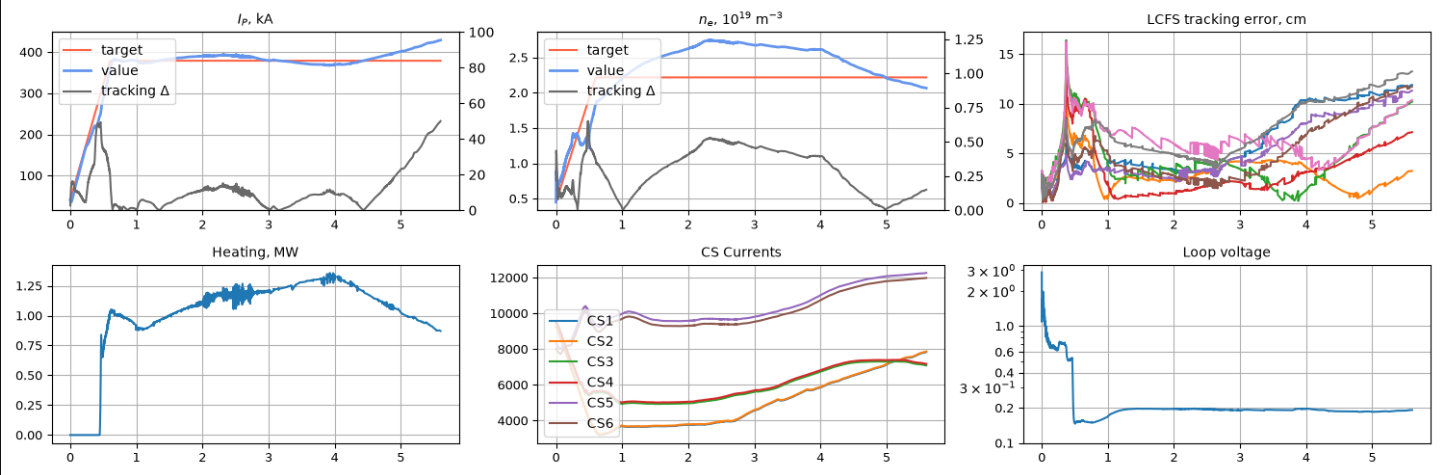
These results remain simulation-based. In particular, the achieved tracking accuracy is more suitable for offline scenario development than direct application to experimental real-time control. The longer discharge tests demonstrate behavior beyond the training horizon, but do not establish general long-term stability or fully non-inductive operation.
Further development
Our next goal is to extend this framework from tracking prescribed plasma trajectories toward optimizing scenarios directly against higher-level performance criteria, including pulse duration, current-drive requirements, and energy gain.
The longer-term application is an automated scenario development workflow in which the designer specifies physical objectives and operational constraints, while the optimization system determines feasible plasma trajectories and the corresponding actuator commands. The current results establish an initial framework for this approach, combining closed-loop plasma control, integrated simulation, and exploration of the operational parameter space.
You can find further technical details and training hyperparameters in our preprint: E. Adishchev et al., “Reinforcement learning controllers for fusion scenario development,” arXiv:2610.26138 (2026).
Next Step Fusion is a supply chain company supporting tokamak developers in the design, simulation, optimization, control, and operation of their devices through integrated modeling and AI/ML-enabled solutions.
We invite you to be part of this groundbreaking journey!
Follow our blog, subscribe to our LinkedIn for regular updates, watch our videos on YouTube, or reach out to us directly to discuss potential collaborations.