The Next Wave of Tokamak Innovations
While the spotlight in fusion research is increasingly shifting toward new formats and private-sector innovation, tokamaks remain at the heart of this technological evolution. This internal review, prepared by a member of the Next Step Fusion team, outlines the global status of tokamak development — both experimental and commercial — and explores what’s next for this foundational technology.
Tokamaks have long been the most proven and extensively studied approach to magnetic confinement fusion (MCF). With over 60 years of track record and more than 200 tokamaks built worldwide, they provide a huge foundation of experimental data and technological advancements. Today, more than 50 operating tokamaks [1] continue to push the boundaries of plasma physics, delivering breakthrough achievements in confinement, heating, and stability.
At first glance, it may appear that the momentum behind tokamak development has slowed. Over the past five years, only a few newly built machines, such as SMART, HH70, and SUNIST-2, have been launched, while other fusion concepts and novel approaches have gained more visibility. But a closer look reveals a different picture. Tokamak development remains highly active, with numerous projects advancing across different stages.
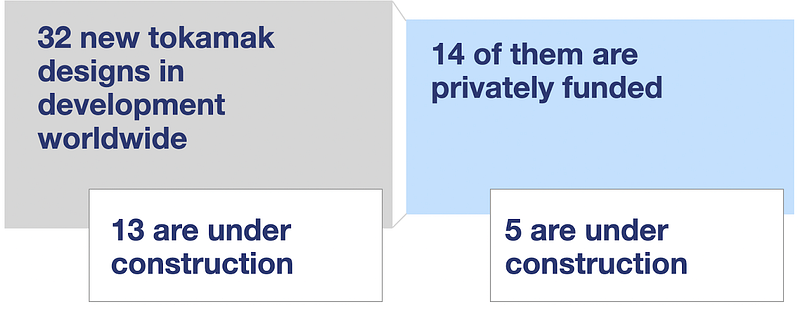
Today, around 32 next-generation tokamaks are in various stages of development worldwide, representing a diverse and rapidly evolving fusion landscape. Based on publicly available data and internal research, these projects range from tokamaks currently under construction to conceptual designs still in the planning stage. Some are large-scale public initiatives focused on advancing fusion power plant concepts, while others are privately developed compact and medium-scale designs aiming for faster commercialization. China and the USA lead the new wave of tokamak development, with the most planned and under-construction projects.
For an up-to-date list of existing and upcoming tokamak projects, please refer to our database here: Tokamaks_Data (updating periodically).
A clear industry shift is emerging, with the fusion sector moving from being primarily government-funded toward private-sector-driven innovation. Notably, almost half of these next-generation tokamaks are private initiatives, signaling a growing commercial push toward practical fusion energy solutions. This trend is both promising and inspiring as private companies bring agility, new technological approaches, and a stronger focus on commercialization, accelerating the path toward viable fusion power.
Tokamaks Under Construction
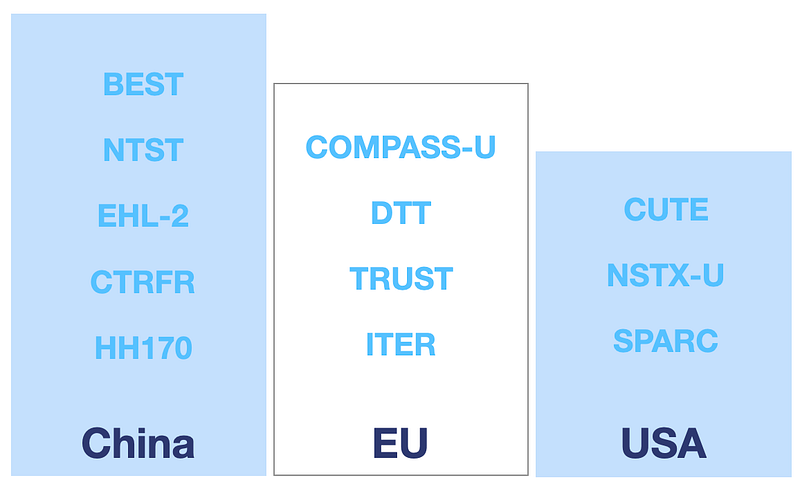
Currently, 13 tokamaks are officially under construction, signaling an unprecedented push toward demonstrating sustained fusion energy production. This includes large-scale public projects (ITER, DTT, and BEST) focused on long-term plasma confinement, power extraction, and fuel cycle validation. Additionally, small and medium-scale public research projects (COMPASS-U, CUTE, TRUST, NSTX-U) are advancing experimental studies and plasma physics research. Meanwhile, five privately funded projects — developed by Commonwealth Fusion Systems (SPARC), ENN (EHL-2), Energy Singularity (HH170), and Startorus (NTST, CTRFR-1) — are working on compact, high-performance machines designed for faster deployment and commercialization.
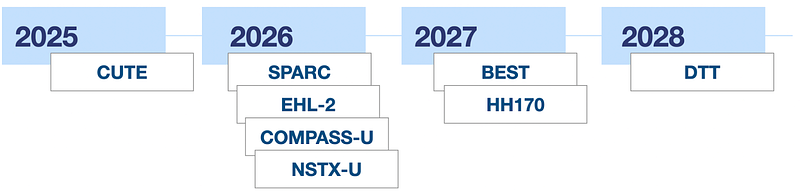
Over the next five years, we expect at least 8 of these projects to be completed, significantly expanding the global experimental capability for fusion research.
As tokamak development speeds up, we are entering a crucial phase in fusion history — one that will shape the future of scalable fusion energy. Tokamak development is steadily progressing toward a new phase, with fusion power plant (FPP) prototypes becoming a central focus.
Transition from Experimental Reactors to Fusion Power Plant Prototypes (FPP)
While previous projects concentrated on understanding plasma behavior and improving confinement, the latest generation of tokamaks is being designed with net energy production, reactor integration, and long-term operation in mind. Several ambitious projects have already been explicitly classified as DEMO or FPP prototypes. These include ARC (Commonwealth Fusion Systems, USA), STEP (UK Industrial Fusion Solutions, UK), STX (Tokamak Energy, UK), CTRFR-2 (Startorus, China), K-DEMO (Korea Institute of Fusion Energy, South Korea), and FAST (University of Tokyo and FAST Project Office, Japan) and JA-DEMO (National Institute for Quantum Science and Technology, Japan).
These concepts are in the early stages and will likely be modified or revised as developing FPP prototypes remains a long-term effort. The expected timelines for these projects vary significantly, with most targeting the 2040s to 2050s for first power generation. This timeframe reflects the challenges of scaling tokamaks from experimental machines to operational power plants, requiring advances in materials science, tritium self-sufficiency, superconducting magnets, and reactor control and maintenance strategies.
The Rise of Spherical Tokamaks
There is increasing interest in spherical tokamaks, which now account for nearly half of new projects. Their compact size, higher plasma pressure, and enhanced confinement efficiency make them a compelling alternative to conventional designs, offering potential cost and performance advantages for future fusion power plants. The UK (STEP, ST-E1, STX) and China (CTRFR-1, NTST, CTRFR-2) are strong proponents of this design.
Next Step Fusion: Supporting the Growth of New Tokamak Initiatives
Now is the time to build new tokamaks not only for the long-term goal of energy production but also for shorter-term purposes such as private research facilities, neutron sources for medicine, materials, fission fuel utilization, and propulsion development.
We recognize that starting a new tokamak project can be daunting for startups and early-stage fusion ventures, often limited by resources, expertise, and funding. This can delay bold ideas, even when the need for innovation and diversified applications has never been more pressing.
Next Step Fusion lowers these barriers by offering an affordable tokamak concept feasibility study, preliminary design, and optimization for specific purposes.
The results and deliverables of these projects enable teams to take concrete steps toward securing funding, attracting partners, and moving confidently into the design and construction phases. We also provide a tokamak digital replica package with simulation services through the Fusion Twin Platform (https://fusiontwin.io).
Our mission is to increase the number of private tokamaks worldwide, accelerating innovation, expanding applications, and helping shape the future of fusion-driven technologies.
Lessons for the Future Innovations
Beyond the tokamak projects currently in design and development, several unrealized tokamak concepts remain — some proposed decades ago, others more recent — that were never built. Notable examples include FNSF, IGNITOR, FIRE, ARIES, TPX, CIT, and GA-FPP. These designs were left for various reasons, such as technological limitations, funding constraints, or shifts in research priorities. However, as fusion technology advances, these past concepts could still hold significant value, offering technical insights and inspiration for new fusion ventures. In fact, some of these designs have already influenced later projects — for example, the TPX design became the basis for KSTAR in South Korea and EAST in China.
Next Step Fusion can help companies by conducting tokamak concept feasibility studies and developing preliminary designs using our suite of design and simulation solutions to assess feasibility, evaluate key parameters, analyze scenario performance, and much more.
Our goal is to grow the global fusion ecosystem, support innovation, and make it easier for new players to enter the sector. Each new tokamak project strengthens the industry — driving technological progress, expanding market potential, and bringing commercial fusion energy closer to reality.
We invite you to be part of this groundbreaking journey. Follow our blog, subscribe to our LinkedIn for regular updates, or reach out to us directly to discuss potential collaborations.
References
[1] INTERNATIONAL ATOMIC ENERGY AGENCY, World Survey of Fusion Devices 2022, Non-serial Publications , IAEA, Vienna (2022)