Welcome the Fusion Twin Platform
We believe that NSFsim, our simulator, is brilliant due to its proven physical approach and focus on practical applications. It has been used for simulations, scenario building, tokamak design optimization, disruption analysis, and training ML models. Who knows what we will use it for tomorrow!
We have always wanted to make it available to the fusion industry to enable research, design, and operations of as many tokamaks as possible, and eventually energy-producing fusion reactors. Importantly, from the very first discussions on these matters, we always thought that for such a live and dynamic tool as NSFsim, it wasn’t enough to publish it in the usual way by simply releasing a complex tool to the community and waiting to see what sticks.
This led us to the idea of delivering NSFsim as a web service. If you think about it, it definitely makes sense because it allows us to:
- let users run the up-to-date NSFsim in exactly the environment and on the hardware it works best on;
- deliver it paired with tested digital replicas of tokamaks that we use ourselves and can easily update to guarantee the best simulations;
- surround it with visualization and management tools that help analyze the data and discover insights;
- enable even better simulations, data management, collaboration, and much more by providing regular updates.
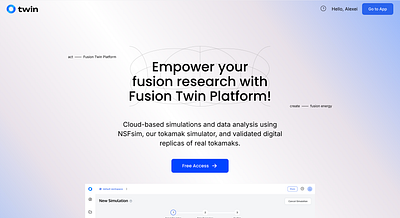
Please welcome the Fusion Twin Platform (fusiontwin.io) — a cloud-based home for NSFsim!
So far, the Platform is capable of running highly customizable magnetic equilibrium simulations of DIII-D, ISTTOK, and NSF NTT tokamaks, visualizing uploaded and simulated files in HDF5 format, and interacting with the data using integrated Jupyter notebooks.
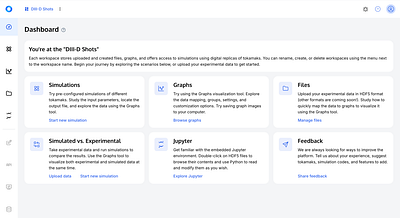
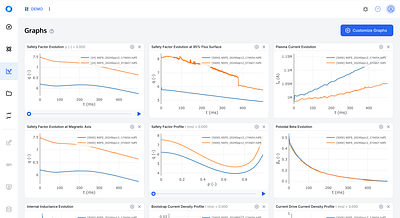
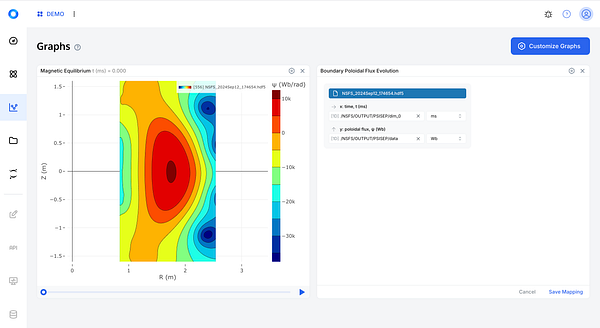
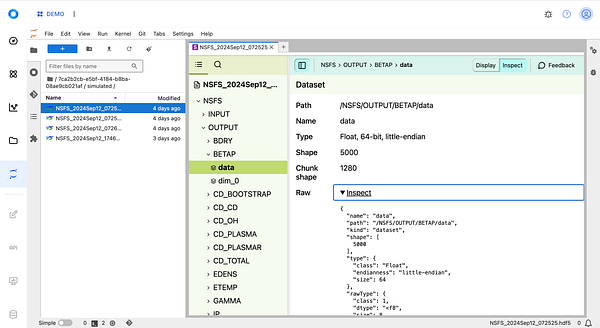
The following useful scenarios are already possible:
- Upload experimental data in HDF5 format and automatically or manually map them to the platform’s variables to visualize using the flexible Graph tool.
- Run Magnetic Equilibrium Simulations using NSFsim for one of the supported tokamaks (DIII-D, ISTTOK, NSF NTT, and other tokamaks coming soon). A wide range of customization parameters allows you to input data for the simulation of any discharge.
- Run a demo of Plasma Boundary Prediction using one of the ML models that we trained with the DIII-D historical dataset.
- Compare simulated discharges to uploaded experimental data using the Graph tool.
- Download any data or images, manage and transform the data using integrated Jupyter notebooks.
With more tokamaks and simulation types, a scenario-building module, LaTeX editor, collaboration tools, discharges database, and public API coming soon, the Platform will truly become a hub for online fusion research. One of the most important upcoming scenarios is the ability to synthesize a new discharge scenario for a selected tokamak, run its variations as many times as needed to achieve the desired plasma state and parameters, and download results as an HDF5 file.
Another prominent range of scenarios concerns education. The Platform could close the gap between theoretical education and practical work on real tokamaks by providing students with a digital environment to study and practice fusion simulations, scenario building, fusion data analysis, and similar skills.
We invite you to check it out today and explore the platform’s great potential to enhance your work. And we would be happy to answer questions and fix stuff for you 😄.
We invite you to be part of this groundbreaking journey. Follow our blog, subscribe to our LinkedIn for regular updates, or reach out to us directly to discuss potential collaborations.