Why Negative Triangularity?
At Next Step Fusion, we believe that recent and upcoming scientific and technological advancements will soon give rise to the fusion power plant industry, providing humanity with safe and affordable energy. Among the various approaches to achieving fusion energy, tokamaks have emerged as the most thoroughly researched, based on the time invested, the number of researchers involved, the development of devices, and the significant scientific and technological progress made. However, even for tokamaks, it is still unclear which specific design or configuration will ultimately become the first commercial fusion power plant, as there are still important discoveries to be made and engineering solutions to be developed.
In this article, we’d like to share one of the ideas we chose to explore, which led us to a wealth of interesting work and, in many ways, has defined the company’s vision.
Successful fusion reactor must confine plasma with both high temperature and high pressure. Usually, such conditions are achieved through enhanced confinement regimes. Historically, the majority of tokamaks are based on so-called positive triangularity (PT, see fig. 1b). Positive triangularity approach leverages well-studied plasma conditions and relatively robust plasma control features, making it favorable for the largest machines worldwide, such as ITER, EAST, KSTAR, and JT-60SA. Similarly, private fusion companies and new projects like SPARC and STEP also adopt these principles.
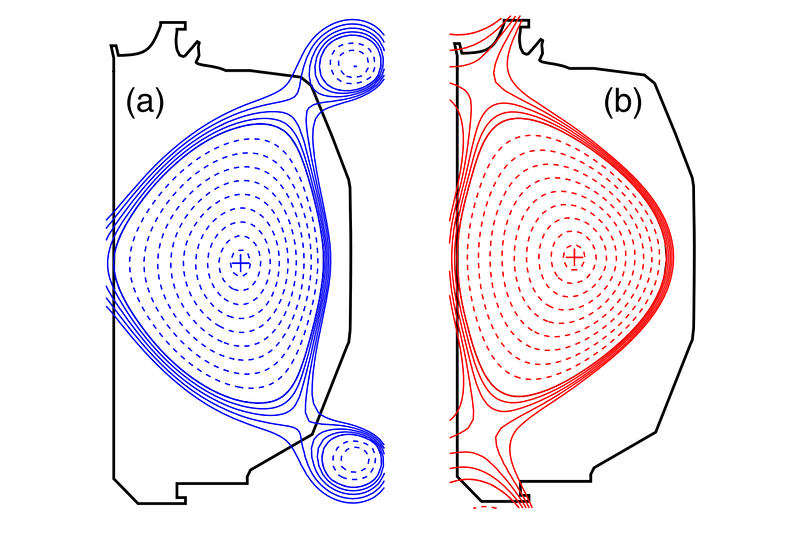
The most significant results in PT plasma were achieved in an improved regime called H-mode [2]. But this success comes at a price. In this regime powerful bursts called Edge Localized Modes or ELMs occur on the edge of the plasma due to high pressure gradients. ELMs can damage the reactor wall, so one should avoid their formation. It can be achieved through ELM suppression by Resonant Magnetic Perturbation of the plasma edge [3] or by establishing regimes which are fundamentally free of ELMs. Another problem of H-mode is enhanced impurities confinement which leads to excessive radiation losses.
Until recently, plasma with negative triangularity (NT, see fig 1a) has not been studied as deep as PT plasma due to lack of stability (see chapter 2.1 in [4]). But results from TCV [5] reignited interest in this topic. Initial research into negative triangularity regimes has shown several advantages. Although no transition to H-mode is observed, NT exhibits the same level of confinement as standard H-mode [6].
Compared to standard D-shaped H-mode plasmas, the NT configuration has lower pressure gradients at the plasma edge and higher gradients in the bulk plasma, providing H-mode grade confinement without ELMs, which is more suitable for reactor’s wall. Operationally, this means that wall and divertor heat loads could be high but will not exhibit extreme damaging levels during ELMs.
The NT design configuration implies that the divertor will be located at the outer side of the reactor. Thus, it can benefit from a larger divertor surface, reducing the overall heat loads at the divertor. These loads can be further reduced with a radiative divertor, where impurities are used to radiate excess exhausted power. Low impurity confinement in NT configuration allows using this approach without significant core plasma performance degradation.
However, NT configurations are usually affected by low MHD stability. This can be partially addressed with tokamak design features (passive stabilization elements) and advanced plasma stability control tools, as demonstrated in multiple experiments at DIII-D and TCV. Recent advancements in machine learning applications for plasma control will provide even more reliable and diverse tools for stabilizing inherently unstable plasma configurations.
At Next Step Fusion, we believe that applying machine learning in the fusion industry will solve many of the challenges currently faced and make fusion reactors more effective, efficient, and ultimately more reliable. Whether for Positive Triangularity (PT) or Negative Triangularity (NT) configurations, machine learning enables real-time detection of plasma states through surrogate models trained on historical experimental data or simulations, such as our very own NSFsim.
Moreover, machine learning could potentially offer robust, real-time control of plasma performance parameters during long discharges, which are essential for sustained energy production in future fusion reactors. Another crucial area is disruption prediction, avoidance, and prevention, where ML could be a game changer as well. These advancements promise to significantly enhance the stability and operation of fusion systems, bringing us closer to achieving practical and reliable fusion energy.
In summary, negative triangularity offers a pathway to achieving high-confinement plasmas without the drawbacks of ELMs and excessive impurity retention. Its ability to maintain high confinement without the need for H-mode transitions opens up new avenues for fusion research, potentially accelerating the development of practical fusion energy solutions.
In combination with machine learning, NT tokamaks emerge as promising candidates for future fusion reactors. Over the past year, our company has collaborated with Columbia University and several other organizations and companies to deeply explore NT tokamak design, simulation, production, and supply chain challenges. This joint effort aims to push the boundaries of what’s possible in fusion energy development and bring us closer to a sustainable energy future.
In our next posts, we will continue exploring the topics of designing and optimizing NT tokamaks, as well as further explain how we use NSFsim, machine learning, and other exciting new technologies and solutions to make fusion energy a reality.
We invite you to be part of this groundbreaking journey. Follow our blog, subscribe to our LinkedIn for regular updates, or reach out to us directly to discuss potential collaborations.
References
[1] M. E. Austin et al Phys. Rev. Lett. 122, 115001 (2019)
[2] F. Wagner Plasma Phys. Controlled Fusion 49, B1 (2007)
[3] W. Suttrop et al Nucl. Fusion 58, 096031 (2018).
[4] A. Marinoni, O. Sauter & S. Coda Rev. Mod. Plasma Phys. 5, 6 (2021)
[5] Y. Camenen et al Nucl. Fusion 47 510 (2007)
[6] A. Marinoni et al Phys. Plasmas 26, 042515 (2019)